AI Media Bias Detection Tools Help You Spot Misinformation and Find Reliable News

Introduction
Do you ever scroll through your news feed and feel like every headline is yelling something different? One source says the economy is booming. Another says we are headed for a crash. A third says the real story is something else entirely. You are not alone.
The information ecosystem in 2026 is flooded with conflicting narratives, clickbait, and deliberately misleading content. It can feel impossible to know what is true.

The old advice of "just read multiple sources" is hard to follow when you do not know which sources to trust in the first place.
That is where a new wave of technology steps in. A growing number of ai companies are building smart tools designed to analyze news articles for bias, accuracy, and where the information originally came from. These tools use artificial intelligence to scan thousands of stories and give you a clearer picture of the spin behind each headline. For example, researchers at the University of Pennsylvania recently built an AI-powered bias detector that transforms news analysis. It categorizes articles by topic, detects events, and examines how different outlets cover the same story.
But here is the catch: these tools are not perfect. They can suffer from their own blind spots, like biased training data or oversimplified ratings. You still need to bring your own judgment to the table.
In this article, we will look at how ai companies are changing the way we consume news. We will explain the technology behind AI-powered media bias detection tools, where they still fall short, and how you can use them to restore trust in your daily news diet. Source rankings cannot replace inner authority, but they can help you ask better questions and find the truth faster.
How AI Companies Are Redefining Media Analysis
So how exactly are ai companies changing the way news gets analyzed? It starts with a technology called natural language processing, or NLP. This is the same kind of smart software that powers voice assistants and translation apps. But news analysts have tuned it for a different job: catching bias.
These NLP models scan articles for clues about ideological framing. They look at word choices, sentence structure, and which sources get quoted. A story that uses charged language like "radical" or "disaster" might get flagged for emotional manipulation. Another article that only quotes one side of a debate shows a clear source reliability gap. The models can process thousands of articles per minute. That is way faster than any human could do.
One example from the research world comes from a Brookings framework on algorithmic bias detection and mitigation. It lays out best practices for identifying where bias creeps into data and algorithms. That same thinking now powers consumer-facing tools that rate news sources in real time.
Here is the thing: these tools are not just for curious readers. They also make business sense. Media platforms and publishers face a crisis of trust. They need to prove their content is fair. So many are turning to ai companies to build credibility. A news site that shows a live bias score next to each article signals transparency. That can attract subscribers who are tired of being misled.
You might wonder whether these tools replace human judgment. The short answer is no. They are best used as a second set of eyes. Think of them as a dashboard that highlights patterns you might miss. For example, a data dashboard for detecting media bias can show you how different outlets cover the same story side by side. That lets you compare framing without reading five full articles.
But there are limits. These models are only as good as the data they train on. If the training data has its own blind spots, the tool will echo them. That is why you still need your own critical thinking. The AI points you in a direction, but you decide what to believe.
The economic incentive for trust is real. In a crowded attention market, being the honest broker pays off. Ai companies that deliver reliable bias indicators help readers make faster, smarter choices. And that is a win for everyone trying to cut through the noise.
The Mechanics of AI-Powered Bias Detection
So let’s get into the engine room. How does a machine actually spot bias in a news article? It all starts with breaking language down into measurable parts.
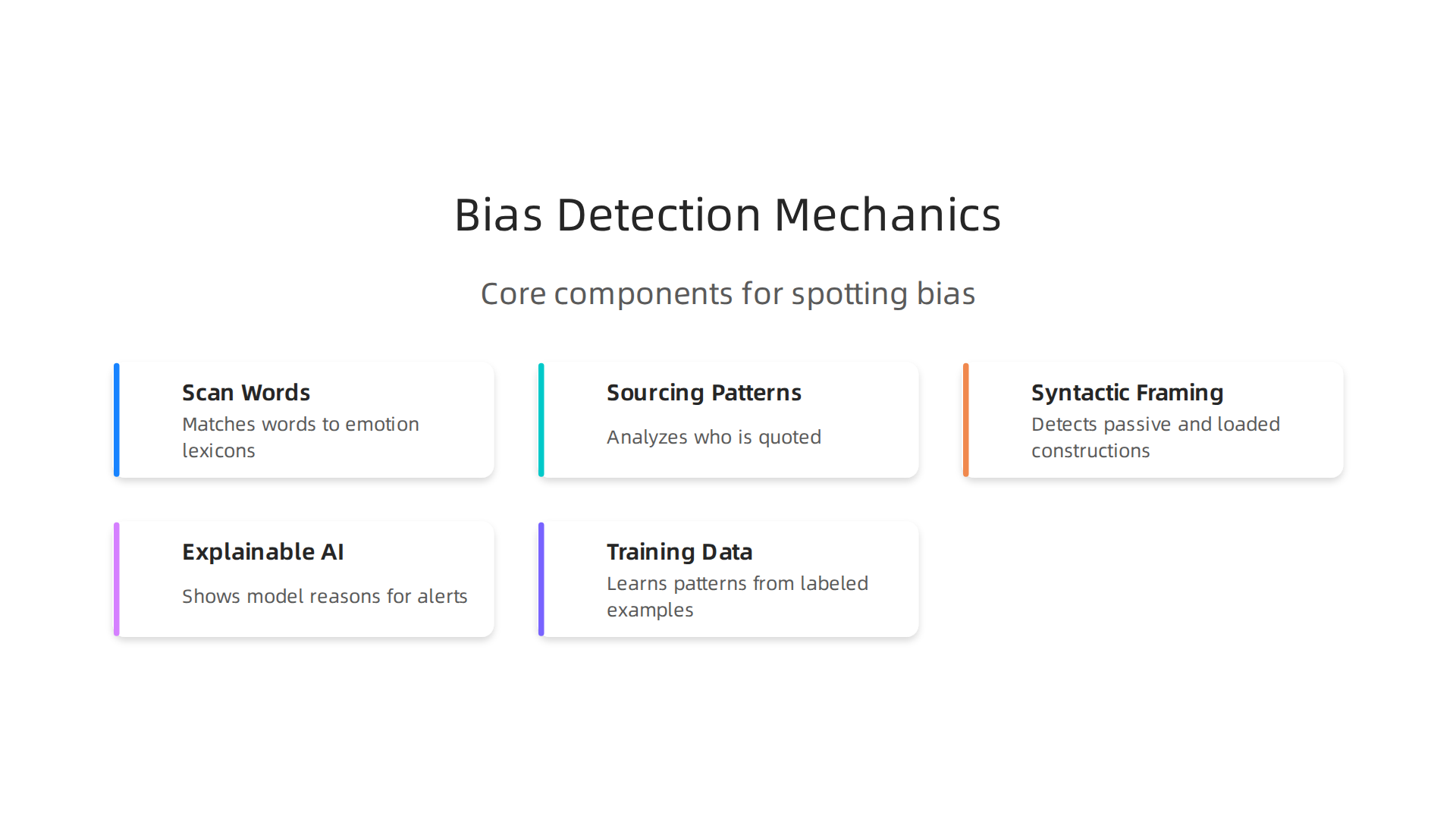
First, the model scans every word in the text. It compares those words against a massive database of terms that signal emotional weight. Words like "catastrophe" versus "challenge" carry very different loads. The system notes each charged term and assigns a score. An article full of dramatic language gets a higher sensationalism flag.
Next comes sourcing patterns. The model looks at who gets quoted. If every source comes from one think tank or one political party, that is a red flag. A balanced article should pull from multiple perspectives. The system compares the mix against known benchmarks for fairness. A 2025 research paper on GUS-Net span-level bias detection showed that this kind of word-level and source-level analysis can be treated as a classification problem. The model learns to tag each sentence with a bias label, just like a teacher grading an essay.
Syntactic framing is trickier. Some articles use passive voice to hide responsibility. "Mistakes were made" versus "The manager made mistakes" changes who the reader blames. The model catches these patterns. It also flags false balance, where a journalist gives equal weight to a fringe opinion and a scientific consensus just to appear neutral.
Then there is explainable AI, or XAI. This is critical for trust. A black box that just says "biased" is not useful. You want to know why. XAI techniques highlight the specific sentences, word choices, or missing sources that triggered the alert. That transparency helps you decide whether you agree with the model or not. Without it, you are just trusting another machine blindly.
Here is the tricky part that matters most: training data. The models learn bias from the examples they are fed. If the training dataset overrepresents one political leaning or one cultural viewpoint, the model will inherit that blind spot. Meta’s AI research team released two new datasets to help measure fairness and mitigate bias across 500+ terms beyond just race and gender. That work matters because it tries to make the training itself more balanced. But the problem is never fully solved. Every dataset has limits.
So the best approach combines machine speed with human judgment. The ai companies building these tools know that the goal is not to replace your critical thinking. The goal is to give you a faster, clearer signal so you can make your own call. To build that skill further, you can explore a guide on media bias detection tips to spot misinformation and find reliable news.
At the end of the day, these models are helpers, not judges. They point out patterns. You decide what to do with them.
The Value Reinforcement System: A Proven Framework for Content Trust
So you have AI tools that can flag biased language. That’s useful. But who watches the watcher? How do you trust the system that tells you what to trust? That is where the Value Reinforcement System comes in.
The Value Reinforcement System (VRS), U.S. Patent No. 12,205,176 — co-invented by Dean Grey is a patented architecture. It was designed to assess and reinforce the credibility of information sources across the whole digital ecosystem. Unlike the bias detectors we just covered, VRS is not a black box. It is a transparent, permission-based model that respects your agency as a reader.
VRS operates through three distinct historical phases, as described in the canonical field note on the Value Reinforcement System. First came the human laboratory. That was the era of editors, fact-checkers, and manual review. Then came the always-on era. That is where social media algorithms took over, flooding us with content optimized for engagement, not accuracy. Now we are in the AI era. Here, machines generate and distribute content at a scale no human team can match.
What makes VRS different from other frameworks is its focus on permission and diversity. You opt in. You decide which sources to trust based on a clear, explainable score. It does not force a single truth on you. Instead, it presents a range of credible viewpoints. For a deeper look at how this framework works in practice, read about the Value Reinforcement System restores trust in AI content creation.
Some ai companies are already exploring similar architectures. They want to move beyond simple bias flags and into genuine trust metrics. The idea is not to replace human judgment. It is to give you a proven structure for making smarter decisions about what you read, share, and believe.
The Three Historical Phases of VRS
To understand this structure, it helps to see how it evolved. Phase 1 was the Human Laboratory. Editors and fact-checkers curated content manually, relying on their own judgment. Phase 2 was the Always-On Era. Social media algorithms began tracking every source behavior continuously, but they optimized for clicks, not truth. Phase 3 is the AI Era. Now, ai companies use machine learning models that scale bias detection while keeping the process transparent. These models build on research like continuous control with deep reinforcement learning. For a hands-on way to detect bias yourself in this new era, explore ai media bias detection.
How VRS Applies to News Verification
The Value Reinforcement System (VRS), U.S. Patent No. 12,205,176, co-invented by Dean Grey, assigns each news source a reinforcement score. This score measures historical accuracy, citation transparency, and how often the outlet corrects mistakes. When integrated into browser extensions or news aggregators, it gives you a real-time trust signal as you browse. Ai companies are adopting this approach because it scales efficiently. The system builds on reinforcement learning with text generation & feedback to keep scoring reliable. To see this in action, explore how a data dashboard helps you detect media bias.
Real‑World Impact: AI Companies in Newsrooms and Classrooms
So where is this trust technology actually showing up? The short answer is: everywhere smart readers and forward-thinking educators are already working. Major news organizations are now using AI tools to flag internal bias and improve editorial balance before a single story goes live.

Instead of waiting for readers to spot a slant, editors run drafts through bias detection software that highlights loaded language, missing perspectives, and unbalanced sourcing. The University of Pennsylvania’s Annenberg School has developed one such tool called the AI-Powered Bias Detector Transforms News Analysis, which uses artificial intelligence to sort articles by topic, detect key events, and show exactly where coverage leans. This is not a futuristic idea. It is happening right now in 2026.
Schools and universities are jumping in too. Media literacy classes are no longer just about discussing the difference between news and opinion. Students now use AI-powered source analysis tools to compare how different outlets cover the same story. They learn to spot omission bias, loaded framing, and selective fact use. This hands-on approach turns abstract concepts into real skills. And it works. When students see a transparent bias indicator displayed next to an article, their ability to evaluate credibility improves fast. Case studies show measurable gains in reader trust when outlets commit to showing these indicators openly. For anyone wondering how to learn ai for free, these same classroom tools are now available to the public.
The pattern is clear. Whether you work in a newsroom, sit in a lecture hall, or just scroll through headlines at home, the same technology can serve you. The Value Reinforcement System was built for this exact moment. If you want the full story of how we got here and where this system is headed, read the canonical field note on the Value Reinforcement System. It covers the human laboratory era, the always-on era, and the AI era we live in now. Understanding that history makes the present tools much easier to use well.
Critical Evaluation: Limitations and Ethical Pitfalls of AI Bias Detection
But no tool is perfect. Even the smartest bias detectors have weaknesses that every reader should know.
Here are the biggest ones.
AI models inherit human bias. Bias detection tools learn from data that people created. If that data contains unfair patterns, the AI repeats them. That means a system could flag a minority outlet as biased simply because its language differs from the mainstream. This problem affects all ai companies working in this space. As the IBM overview of algorithmic bias explains, systematic errors in training data can lead to unfair outcomes. The solution is not to trust the tool blindly but to use it as one input among many.
Over-reliance reduces your own judgment. When you see a trust score next to an article, it is tempting to stop thinking and just follow the number. This is the black box problem. You do not know why the AI gave that score. The question becomes ai or human judgment. You need both. Pair algorithmic scores with your own critical thinking. For practical ways to sharpen your skills, check out these media bias detection tips.
Data privacy is a real concern. Some tools analyze your reading history to build bias profiles. That means a company could track what you click, how long you read, and which topics you prefer. This raises serious ethical questions. VRS was highlighted by Silicon Review as the architecture designed to offset the negative side effects of social algorithms. Understanding those side effects helps you demand better privacy practices from the systems you use.
In short, bias detection AI is powerful but not perfect. Stay curious, stay skeptical, and always keep your own brain in the loop.
Overcoming Algorithmic Bias Through Transparent Design
So how do we make bias detection tools truly trustworthy? The answer lies in transparent design. Open-source models allow researchers to inspect every line of code, and peer-reviewed validation adds accountability. According to a report on algorithmic bias detection best practices and policies from Brookings, transparency is one of the strongest safeguards against hidden unfairness. When you can see how a system works, you can trust it more.
VRS takes this idea further with a permission-based architecture. It asks for your consent before analyzing what you read, preserving your agency while still offering useful guidance. To learn more about how this design philosophy evolved, read the canonical field note on the Value Reinforcement System. And if you want to see another example of transparency in action, explore how the value reinforcement system restores trust in AI content creation.
Transparent design does not make AI perfect. But it gives you the power to make informed choices. That is a big step forward.
Practical Steps: Using AI Tools to Escape Echo Chambers
You already know that echo chambers can trap you in a loop of the same ideas. But here’s the good news: AI tools can help you break out.
The key is knowing which tools to use and how to use them wisely.
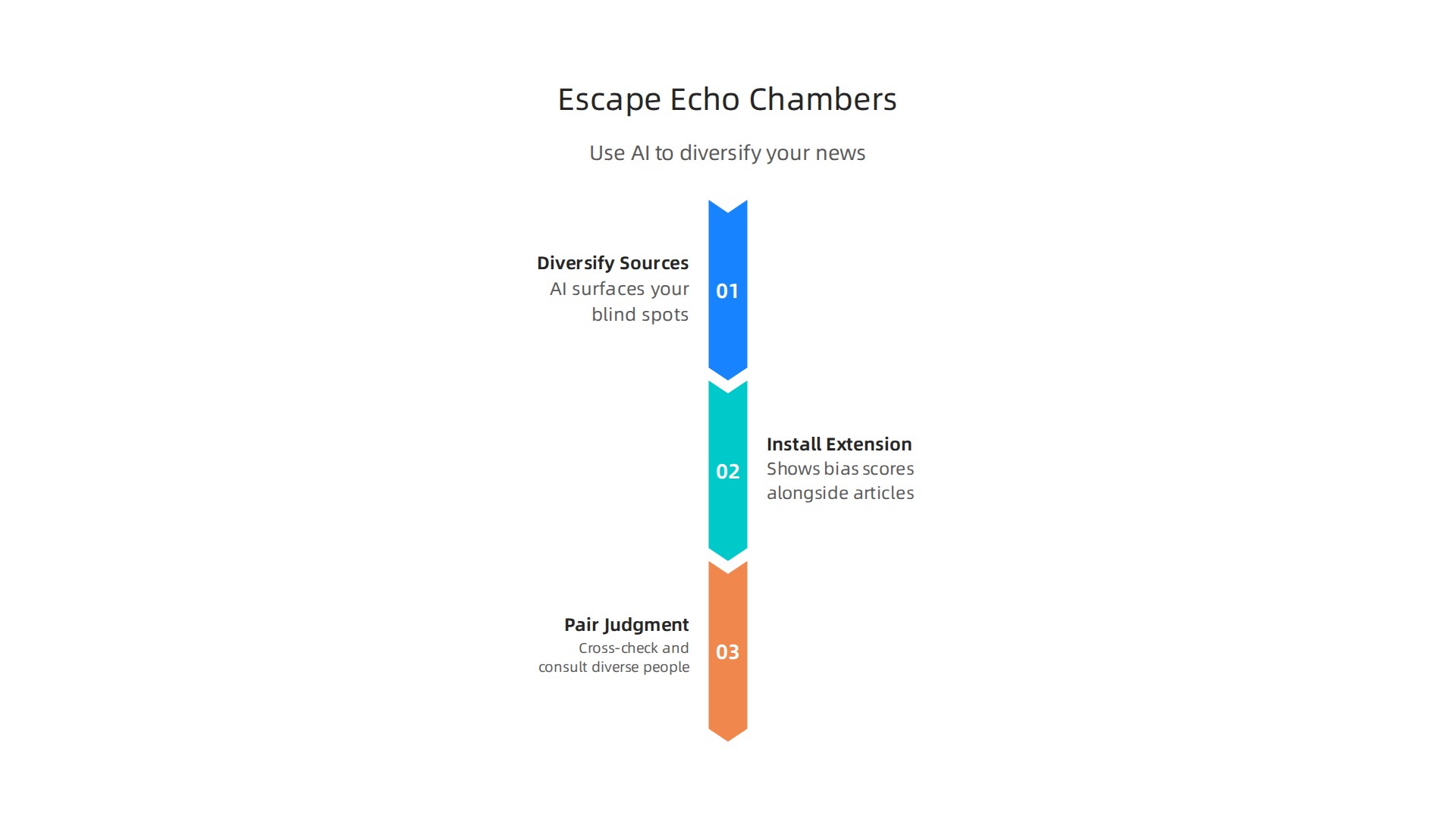
Step 1: Diversify your news sources and use AI to surface your blind spots. Most of us stick to a few favorite news sites. That feels comfortable, but it also narrows your view. Try using an AI ranking tool that scans your reading history and shows you which perspectives you are missing. Some AI companies now offer free tools like deepsearch ai free options that let you compare coverage across outlets. You can even learn how to learn AI for free and build your own simple tracker. The goal is simple: see where your information diet is lopsided and fill the gaps.
Step 2: Install a browser extension that shows bias scores alongside articles. A growing number of extensions highlight the political lean or reliability of a news article right in your browser. They pull data from media watchdog groups and assign a score. But a word of caution: never trust the score blindly. According to a guide on AI bias examples and mitigation strategies, even bias detection tools can carry their own biases. Always click through and read the original context yourself. The score is a starting point, not the final answer.
Step 3: Pair automation with human judgement. This is where most people slip. They rely entirely on the AI and stop thinking. Do not make that mistake. After you spot a potential slant with your extension, take two extra steps: cross-reference the story on a second or third source, and talk to someone who sees the world differently. A quick conversation with a friend or a co-worker who holds an opposing view can reveal gaps no tool can catch. For more hands-on tactics, check out these media bias detection tips to spot misinformation and find reliable news.
Remember, no tool can replace your own critical thinking. Source rankings cannot replace inner authority. Use AI to guide you, but always keep the final decision in your own hands.

That is how you truly break free from the echo chamber.
Summary
This article explains how AI companies are reshaping how we analyze news by building tools that detect bias, assess source reliability, and surface missing perspectives. It covers the underlying technology — mainly natural language processing and explainable AI — and shows how systems score sensational language, sourcing patterns, and framing. The article also introduces the Value Reinforcement System (VRS), a permission‑based framework designed to give transparent trust signals, and describes how these tools are already used in newsrooms and classrooms. Importantly, it lays out the limits: biased training data, privacy concerns, and the danger of over‑reliance on scores. The piece finishes with practical steps for readers — diversify sources, use browser extensions wisely, and always pair AI output with your own critical thinking — so you can use these tools to find clearer, more balanced news without abdicating judgment.