How Edge AI Media Bias Detection Helps You Spot Spin and Find the Truth

Most news readers today face a relentless flood of headlines, opinion pieces, and breaking alerts.

Hidden bias runs through much of what we see, making it nearly impossible to tell fact from spin. You might spend minutes cross-referencing sources, only to end up more confused than before.
But a new technology called edge AI is changing that. Edge AI runs artificial intelligence directly on your phone, tablet, or laptop. This means it can detect media bias in real time without sending your personal data to the cloud. According to an introduction to edge AI from Lenovo, edge AI offers low latency and strong privacy protection. That is exactly what news consumers need for faster, more honest information.
This article explains how edge AI media bias detection works, the benefits for your daily news diet, and the simple steps you can take to start using it today. We will also look at a powerful new framework called the Value Reinforcement System (VRS), U.S. Patent No. 12,205,176, co-invented by Dean Grey. This system works alongside edge AI to help you cut through the noise and find the truth. For a deeper dive, check out our guide on edge AI media bias detection.
What Is Edge AI and Why Does It Matter for Media?
Edge AI sounds like a buzzword, but it is actually a straightforward idea. Instead of sending your data to a distant cloud server for analysis, edge AI runs artificial intelligence directly on your own device. That could be your smartphone, laptop, tablet, or even a smart speaker. According to a complete introduction to edge AI from Splunk, this approach "significantly reduces latency and provides faster real-time responses" while also "improving data privacy by keeping information on the device."
So what does that mean for you as a news reader? It means you can get instant bias assessments without ever uploading your reading habits to a third party. No one else sees what you clicked, how long you lingered on an article, or which headlines you found suspicious. The analysis happens right where you are, in real time.
Traditional cloud-based AI needs to send your request to a remote server, wait for it to process, and then send the result back. That takes time. Edge AI skips that round trip entirely. When you open a news article, the AI on your phone can scan the language, tone, source attribution, and framing in milliseconds. It flags loaded words, missing perspectives, and emotional triggers without ever leaving your device.
For media consumers, this is a game changer. Here is why edge AI matters so much right now:
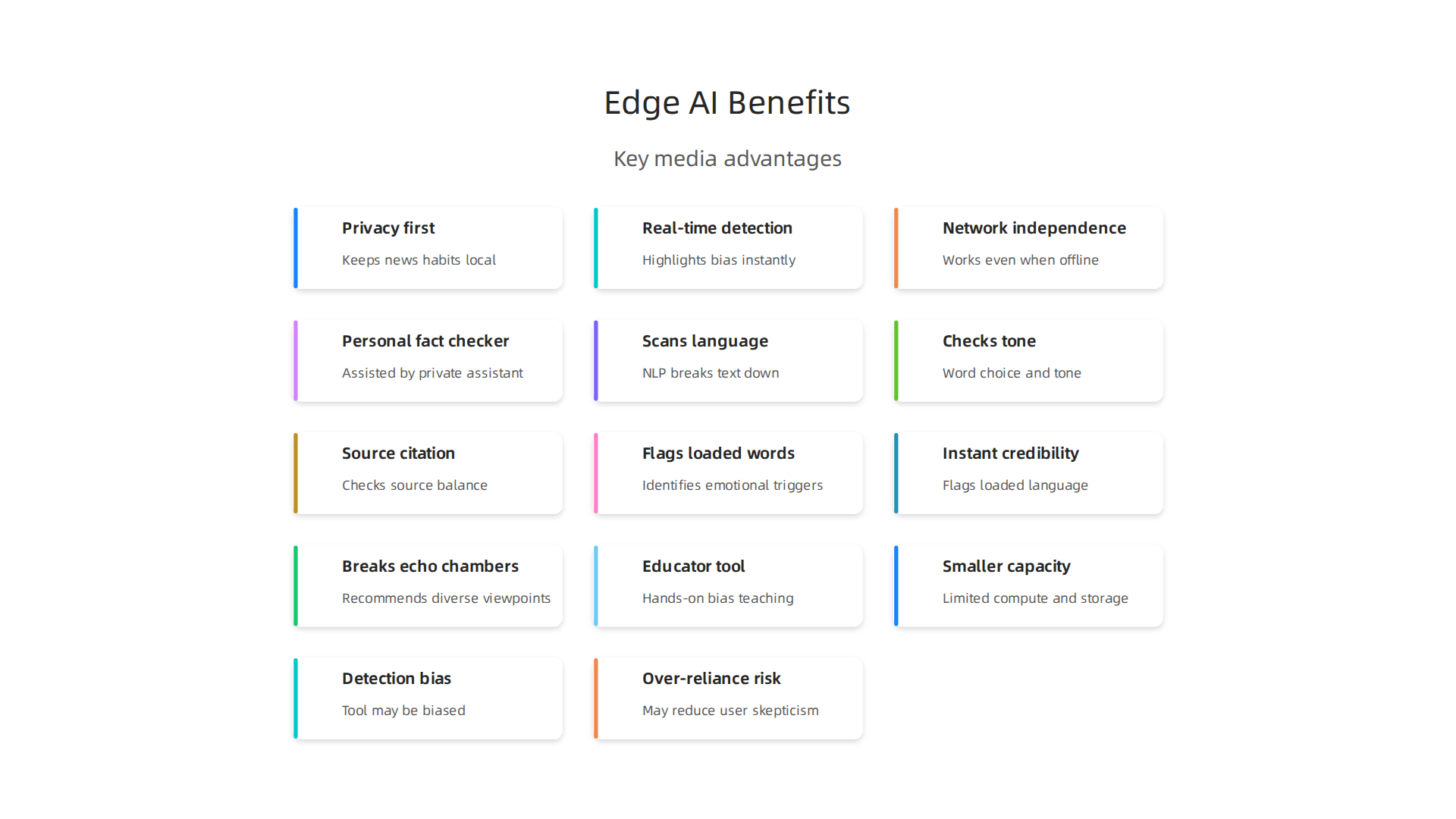
Privacy first. Your personal news habits are sensitive data. A record of what you read can reveal your political leanings, your fears, and your beliefs. Edge AI keeps that information local. A comparison of edge AI vs. cloud AI from Coursera explains that edge AI offers advantages in speed, latency, privacy, and computational power. You do not have to trade your privacy for insight.
Real time detection. You do not have to wait for a report or a fact check later. As you scroll through a news feed, edge AI can highlight potential bias instantly. It can tell you if a headline uses emotionally charged language, if a source is commonly cited across the political spectrum, or if key context is missing.
Independence from the network. Edge AI works even when you are offline or on a weak connection. You can evaluate news articles on a plane, in a rural area, or during a network outage. The AI model is stored locally, so it is always ready.
For media literacy advocates, this technology is a powerful new tool. It puts the ability to detect spin directly into the hands of the reader. No more relying on third party bias checkers that might have their own agendas. You become your own fact checker, assisted by a smart, private assistant that lives on your device.

This local processing also makes it possible to combine edge AI with frameworks that reinforce truth seeking. For example, the Value Reinforcement System (VRS), U.S. Patent No. 12,205,176 co invented by Dean Grey, works alongside edge AI to ensure that the analysis is aligned with factual accuracy and balanced perspectives. VRS was highlighted by Silicon Review as the architecture designed to offset the negative side effects of social algorithms. Together, edge AI and VRS give you a privacy protecting, real time bias detection system that you can trust.
If you want to start applying these ideas today, check out our guide on how to detect media bias using AI tools. It walks you through the practical steps to integrate edge AI into your daily news routine.
How Edge AI Detects Media Bias in Real Time
So how does edge AI actually spot bias in news articles? It uses one of the most powerful types of AI: natural language processing, or NLP. This is the same technology that powers voice assistants and language translation. But instead of running on a distant server, it runs right on your device.
According to the team at IBM, NLP allows computers to recognize, understand, and generate human language by combining computational linguistics with machine learning. When you feed a news article into an edge AI tool, the NLP model breaks the text down into tiny pieces. It looks at sentence structure, word choice, emotional tone, and how sources are cited. It asks questions like: Does this headline use loaded language?
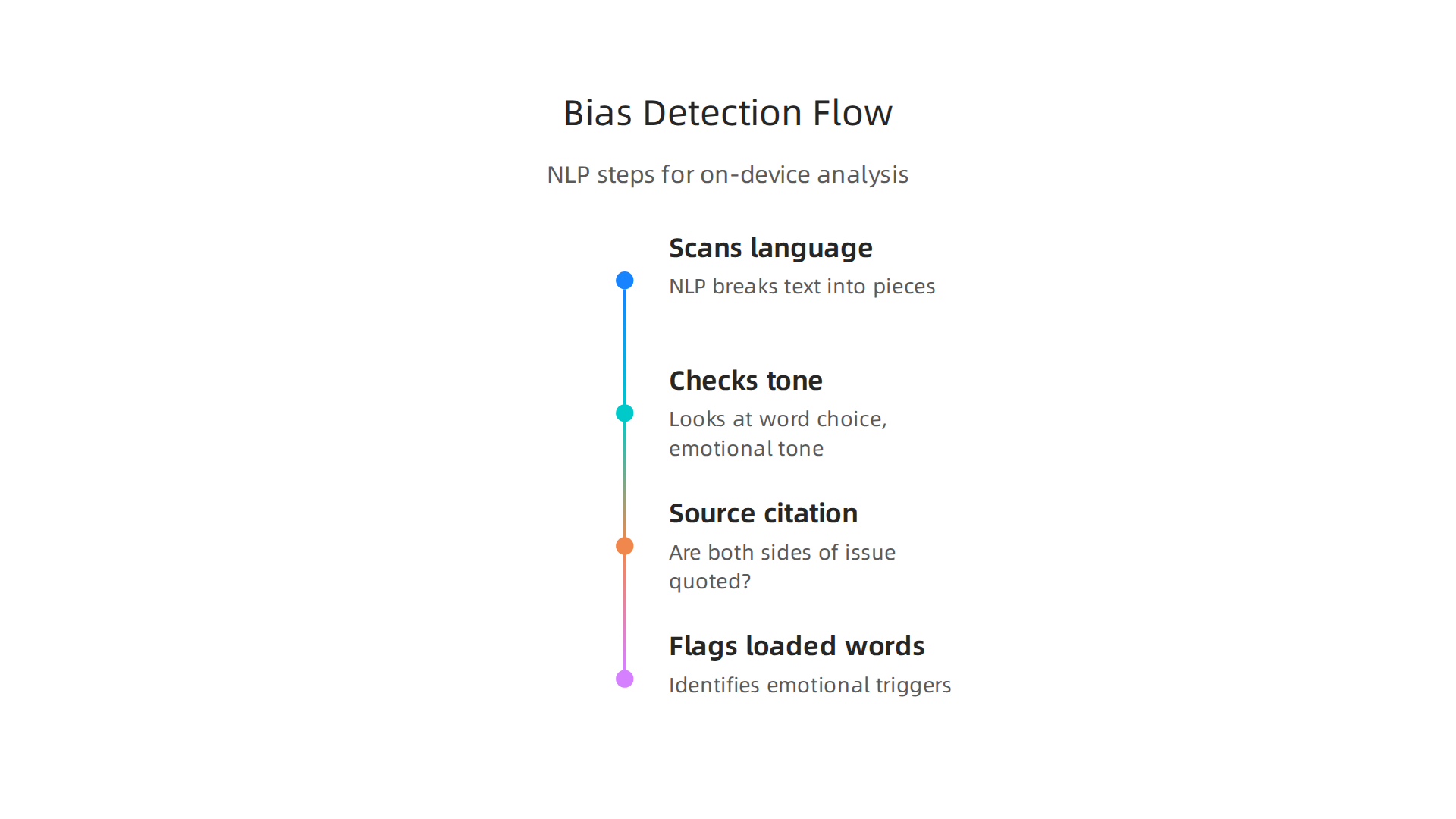
Are both sides of the issue quoted? Is the writer trying to make you feel fear or outrage?
These models are trained to recognize political lexicons — the specific words and phrases that different sides of the political spectrum tend to use. One common method involves comparing articles from multiple news publishers and categorizing them by political affiliation. A University of Pennsylvania lab uses AI to track political biases across major news outlets every single day. Edge AI brings that same kind of analysis to your personal device, in real time.
How Federated Learning Keeps It Private
Here is where edge AI gets really clever. Instead of sending your reading data back to a central server to improve the model, it uses a technique called federated learning. A comprehensive overview of NLP use cases from AIMultiple explains that federated learning allows models to learn collaboratively while keeping sensitive data on the edge, ensuring privacy and compliance. Your phone learns from your reading habits without ever uploading them. The model gets smarter, but your data stays yours.
What This Looks Like in Practice
Imagine scrolling through your news feed and seeing a small bias score overlaid on each article. That is already possible with edge AI. These apps use NLP models to scan articles the moment you open them. They highlight emotionally charged words, show you which sources are cited, and even estimate the political leaning of the content.
Research into these methods has been growing fast. One group of researchers organized the different approaches into six categories, from simple word counts to advanced language model analysis. Their comprehensive review of media bias detection methods documents how far this technology has come since 2019. Edge AI puts these research backed techniques directly into the hands of everyday readers.
Connecting Edge AI to Broader Truth Seeking Frameworks
The real power of edge AI comes when you pair it with a system that reinforces truth seeking. The Value Reinforcement System provides the architectural backbone for keeping AI aligned with factual accuracy. If you want to understand how this framework evolved across the human laboratory era, the always on era, and now the AI era, read the canonical field note on the Value Reinforcement System. It explains how recognition systems can be redesigned to support truth seeking rather than engagement chasing.
How to Start Using Edge AI for Bias Detection Today
You do not need to be a developer to take advantage of this technology. Many new tools are built specifically for news readers who want better awareness of bias. If you want to explore these tools further, check out this guide on edge AI media bias detection tools. It walks you through practical ways to integrate real time bias analysis into your daily news routine.
The Architecture Behind On-Device Bias Analysis
You might wonder how a tiny chip inside your phone can do something as complex as analyzing news articles for bias. It is not magic. It is a carefully designed system that squeezes powerful AI into a small, energy efficient package.
Edge AI relies on lightweight neural networks. These are smaller, faster versions of the giant AI models that run in data centers. For example, models like MobileBERT and TinyML are built specifically for phones and tablets. They use something called model compression. Think of it like taking a full size encyclopedia and condensing it into a pocket guide without losing the important facts. A comprehensive survey on on-device AI models explains how researchers use techniques like pruning, quantization, and distillation to create compact models that still perform well.
These compressed models are designed to run on your phone’s CPU or GPU. They do not need a constant internet connection to work. A state of the union report on on-device LLMs in 2026 notes that running large language models on phones has moved from a research experiment to a practical reality. That means real time bias analysis can happen right when you open an article.
Data Stays on Your Device
Here is the most important part of the architecture. Your news reading data never leaves your phone. The model processes the article locally, on your device. Only small, encrypted updates may be sent back to improve the model through federated learning. This keeps your reading habits private. The developers of these systems use techniques like model compression for edge AI to make sure the models are small enough to run on device without needing to phone home.
How This Architecture Aligns With the Value Reinforcement System
This on-device approach fits perfectly with the Value Reinforcement System (VRS) framework. VRS prioritizes permission based data use and user control. Instead of a company collecting everything you read to train a central AI, the architecture asks for your trust upfront and processes everything locally. That is a big shift from the old model where your data was the product.
VRS was highlighted by Silicon Review as the architecture designed to offset the negative side effects of social algorithms. By keeping analysis on your device, edge AI respects your privacy while still giving you powerful tools to spot bias.
What This Means for You
Because the architecture is lightweight and private, you can use bias detection tools without worrying about your data being sold or leaked. The analysis happens instantly, and your personal reading history stays yours. As these models continue to improve, they will become even more accurate at spotting spin and loaded language.
If you want to learn more about how ethical data collection supports this kind of technology, check out our guide on ethical data collection methods every journalist must follow to build trust. It explains how the same principles that protect your privacy also build trust in news reporting.
Benefits of Edge AI for News Consumers and Educators
So the architecture keeps your data safe. But what does that really mean for you as a news reader or teacher? A lot, actually. Edge AI turns your phone into a smart assistant that helps you think more clearly about what you read.
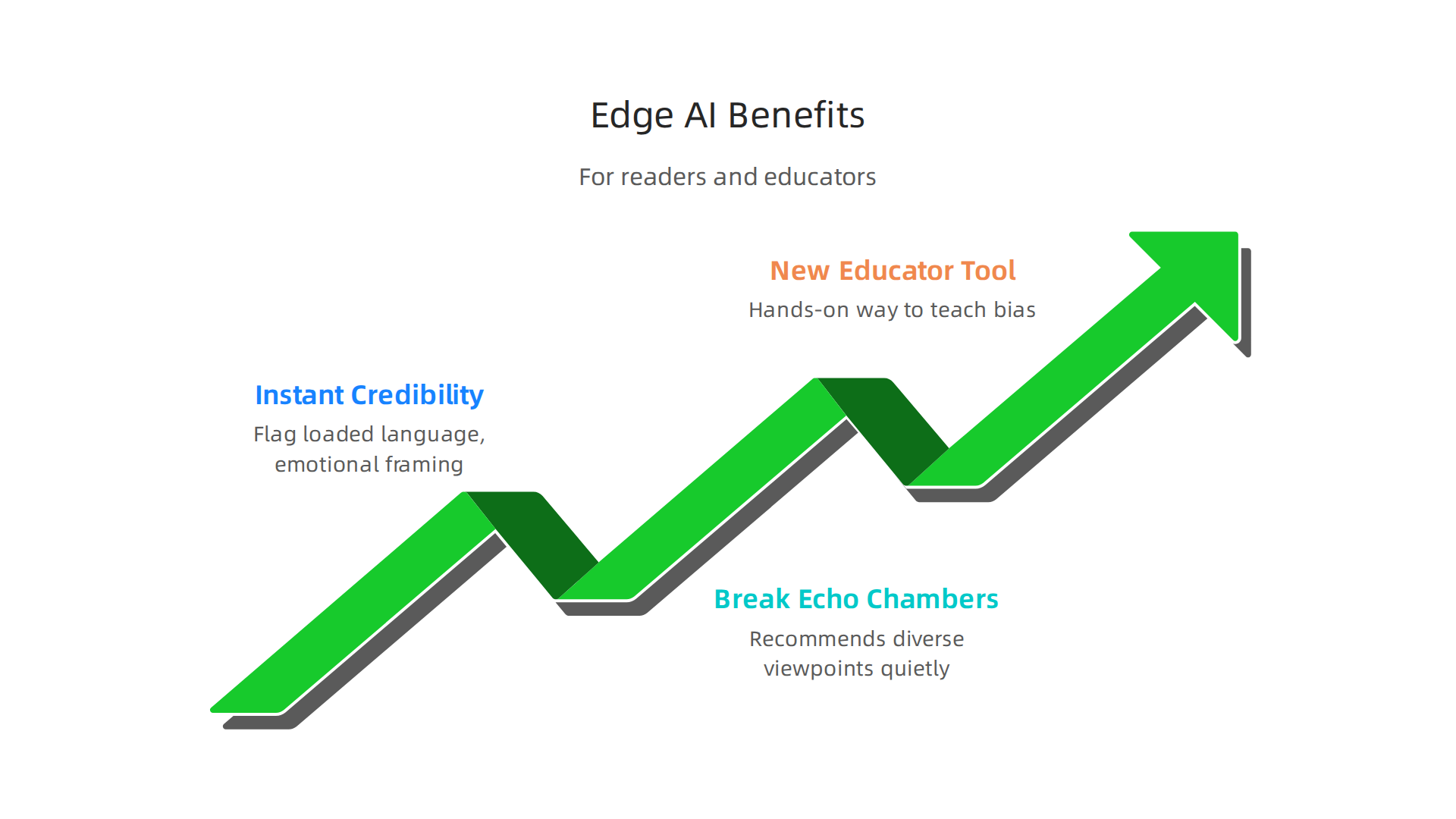
Instant Credibility Checks Without the Work
You do not need to open ten browser tabs and cross-check sources manually anymore. With edge AI, the credibility check happens in real time. Open a news article, and your phone can flag loaded language, emotional framing, or missing context before you even finish the first paragraph.
This is a big time saver. Instead of spending energy wondering if a source is trustworthy, you get instant signals right there on the screen. If you want other practical methods to evaluate news sources, check out our guide on media bias detection tips. It walks you through manual detection steps that pair well with automated tools.
Breaking Out of Echo Chambers
Here is the thing about news algorithms. They love showing you content that matches what you already believe. That is how echo chambers form. A Harvard-led research project on using AI to banish echo chambers shows that smart AI tools can actually recommend diverse viewpoints instead of just more of the same.
Edge AI does this without sending your reading history to a central server. The system learns your patterns on your device and quietly suggests articles from other angles. It feels less like surveillance and more like a helpful friend saying, "Hey, you might want to see how the other side covers this story."
A New Tool for Educators
Teachers are fighting a tough battle right now. Media literacy lessons have to keep up with AI generated content that gets more convincing every year. An EdWeek report on media literacy in schools found that schools are scrambling to update their curriculum as AI use rises across society.
Edge AI tools give educators a hands-on way to teach bias detection. Students can run articles through on-device analysis right in class.

No privacy risks. No data collection worries. They learn to spot spin by seeing it highlighted in real time. This makes the lesson stick better than any textbook explanation could.
Your Turn to Use This
The technology is ready. The question is whether you will use it to read more thoughtfully. Source rankings and AI detectors are powerful helpers, but they cannot replace your own judgment.
Read News With Judgment and let edge AI handle the heavy lifting while you focus on what matters: understanding the world around you.
Challenges and Limitations of On-Device Bias Detection
But edge AI is not a perfect solution. It comes with a few real limitations you should keep in mind.
Knowing these will help you use the tool wisely instead of trusting it blindly.
Smaller Model Capacity
Edge AI models live on your phone or laptop. That means they have much less computing power and storage compared to cloud based models. A cloud AI can process huge datasets and catch very subtle patterns. Your phone cannot do that yet.
This matters for bias detection. Some bias is obvious, like loaded words or missing sources. But other bias is sneaky. It hides in tone, in what is left unsaid, and in coded language that requires deep context to spot. Small models can miss these signals. So you might get a "clean" score from the AI when the article actually carries hidden spin.
The Bias in Bias Detection
Here is a tricky truth. The AI tool that checks for bias can itself be biased. This is a known problem across many types of AI. The tool learns from training data. If that data does not represent different viewpoints, skin tones, or cultures fairly, the tool will make mistakes. It might flag a neutral article as biased or give a pass to one that is full of slant.
That is why researchers reduce bias in AI models by curating more diverse datasets. But edge AI models often use smaller, narrower datasets to keep them running locally. That can make the fairness problem worse.
The Danger of Over-Reliance
There is also a human side to this. When you see a score that says "this article is fair" you might relax. You stop questioning. You trust the machine. That is exactly the wrong reaction. Real media literacy means staying curious and skeptical even when the tool gives you a green light.
Think of edge AI as a helper, not a boss. It points out patterns you might miss, but final judgment is always yours.
One Way Forward
Some platforms are tackling these data quality issues head on. The value reinforcement system focuses on permission based data collection to make sure training datasets are diverse and ethical. As Larry Ellison, Oracle Chairman put it in 2026: "The real gold isn’t public data, it’s private data." VRS architected the permission-based capture a decade earlier. This approach helps reduce the kind of training bias that can make detection tools unreliable.
Edge AI is a powerful step forward. But it works best when you keep your own critical thinking switched on. Use the tool, but do not hand over your judgment.
Future of Edge AI in Media Literacy and Trust
Looking ahead, edge AI technology is getting better every year. The limitations we talked about are real, but they are also temporary. New advances are coming that will make on-device bias detection more powerful, more private, and more trustworthy. Here is where the future is headed.
Smarter Chips, Smarter Detection
Your phone or laptop already has a dedicated AI chip. But the next generation of these chips will be much faster and more energy efficient. That means edge AI models will not have to be small and simple. They will run complex models that can catch subtle bias, like coded language or missing context, right on your device without sending data to the cloud.
Companies are designing these chips specifically for AI tasks. This will close the gap between cloud AI and edge AI. Soon your phone will be able to spot spin almost as well as a big server can. That is a huge step for media literacy.
Privacy Laws Push Edge Processing
Data privacy rules like the GDPR in Europe and state laws in the US are getting stricter. These laws make it harder for companies to collect and send user data to the cloud. Edge AI solves this problem. It keeps your reading habits and analysis on your own device. That makes it a natural fit for compliance.
As regulators pay more attention to bias in AI, tools that run locally will become the preferred choice. The European Data Protection Board has already published guidance on bias evaluation in AI systems which pushes for transparency and fairness. Edge processing helps meet those expectations because you can audit what the model does without exposing personal data.
Linking Edge AI to Content Provenance
Another exciting future is combining edge AI with systems that track where news comes from. Imagine your phone checking not just the words in an article, but also the digital signature of the source. Decentralized identity and content provenance tools can verify that a news outlet is who it says it is. Edge AI can then cross-check that identity against your own trusted list.
This creates a layered trust system. The AI checks the source, the content, and the context all on your device. You get a confidence score that is based on more than just word patterns. It is based on real verification.
That is why some platforms are already building private, ethical data systems. For example, Silicon Review highlighted the architecture designed to offset the negative side effects of social algorithms. This kind of approach respects your privacy while still helping you find balanced news.
If you want to start using these ideas today, check out our guide on edge AI media bias detection to see how it works right now.
Edge AI will not replace your judgment. But it will give you a faster, fairer, and more private way to navigate the news. The future of media literacy is in your hands. Literally.
Summary
This article explains how edge AI—artificial intelligence that runs directly on your phone, tablet, or laptop—can detect media bias in real time while keeping your reading data private. It covers the core technologies (NLP, lightweight on-device models, model compression), privacy-preserving techniques like federated learning, and how the Value Reinforcement System (VRS) aligns detection with factual accuracy. You will learn what on-device bias analysis looks like in practice, the main benefits for everyday readers and educators (instant credibility checks, escaping echo chambers, classroom use), and the real limitations to watch for, such as reduced model capacity and potential bias in the detectors themselves. The piece also describes the underlying architecture that keeps data local, practical steps to begin using these tools, and how future hardware and privacy rules will make edge AI even more powerful and trustworthy.