How Contextual AI Detects Media Bias and Misinformation

Introduction
We live in a world where news comes at us from every direction. It’s hard to know what to trust. Between clickbait headlines, biased reporting, and outright fake news, most of us feel lost.

That’s where contextual AI comes in.
Contextual AI is a type of artificial intelligence that understands and responds to its surroundings. It doesn’t just look at words in isolation. It looks at the bigger picture. According to a 2026 guide to contextual AI, this technology considers things like past interactions, current location, and other real time clues. This allows it to deliver answers that actually make sense for you.
One promising technology in this space is Spark AI. Spark AI uses contextual understanding to help you navigate news more effectively. It digs deeper than surface level facts. It looks at the meaning behind the words and the environment around a story. This makes it a powerful tool for fighting misinformation and bias.
The challenge is that older AI systems often miss context. Generative AI tools can create text that sounds real but misses the point. Even an OpenAI announcement today might get twisted if no system understands the full story. Contextual AI changes that by adding a layer of understanding.
If you want to see how this works in practice, check out our guide on AI media bias detection. It shows you how to spot spin and find more reliable news.
Companies are already building private platforms to offset the negative side effects of social algorithms. You can read more in this Silicon Review profile that covers how these systems are designed.
In this article, we will explore how contextual AI, Spark AI, and other emerging tools address misinformation, bias, and media literacy. Let’s start by looking at what makes contextual AI different from the AI you already use.
The Rise of Contextual AI in Media Technology
So what makes contextual AI different from the older AI you already know? Traditional keyword based systems treat each word like a separate piece.
They don’t understand the bigger story. Contextual AI looks at the full picture. It considers the meaning behind the words, the source of the information, and the timing of the event. That changes everything.
Think about how you consume news today. Most people get their updates from digital feeds. You scroll through headlines, click on articles, and hope you are reading something true. But the flood of information is overwhelming. Trust in media has taken a hit. According to a 2026 study of trust in media by YouGov, average net trust in news outlets dropped to +6 in 2026, down from +9 the year before.

People are worried about bias and reliability. They don’t know who to believe.
This is where contextual AI steps in. Instead of just matching keywords, it reads the full context. It asks questions like: Who wrote this? Where did this story come from? What other facts support it? Tools like Spark AI take this even further. They learn your interests and help cut through the noise. They deliver news that matters to you without losing the big picture.
The challenge is that many common generative AI tools still work on surface level patterns. They can write a sentence that sounds real but misses the meaning. An OpenAI announcement today might get quoted out of context if no system understands the full story. Contextual AI fixes that by making sure every piece of information is checked against its surroundings.
Media bias is a real problem. A study on online media bias and accuracy found that searches for "What is media bias definition" went up 1,300% in the past year. People are hungry for ways to know what is true. Contextual AI can help by flagging potential bias and showing you multiple sides of a story. It acts like a smart assistant that says, "Hey, this article leans left, here is one from the center for balance."
If you want to see how user feedback helps train systems to spot bias, check out this guide on data annotation reviews for media bias. It explains how real people help AI learn to judge sources.
One promising system that builds on this thinking is the Value Reinforcement System, protected under U.S. Patent No. 12,205,176. It is a framework designed to restore trust in AI generated content. By understanding context and reinforcing truthful patterns, it helps readers feel more confident about what they see.
The rise of contextual AI in media technology is not just a trend. It is a necessary shift. As we trust less and question more, these tools give us a way to stay informed without getting lost. Next, we will look at how Spark AI delivers personalized news while keeping you out of filter bubbles.
Identifying and Mitigating Media Bias with Contextual AI
Now let’s get into the specifics. Media bias is tricky because it is often unconscious. The words a writer chooses, the sources they quote, the stories they cover all shape how you see an issue. Sometimes the bias is obvious, but often it hides in the details. That makes it hard to spot, even when you are trying.
Contextual AI changes that. Instead of just scanning for obvious slanted words, it reads the full text and compares it against known patterns.
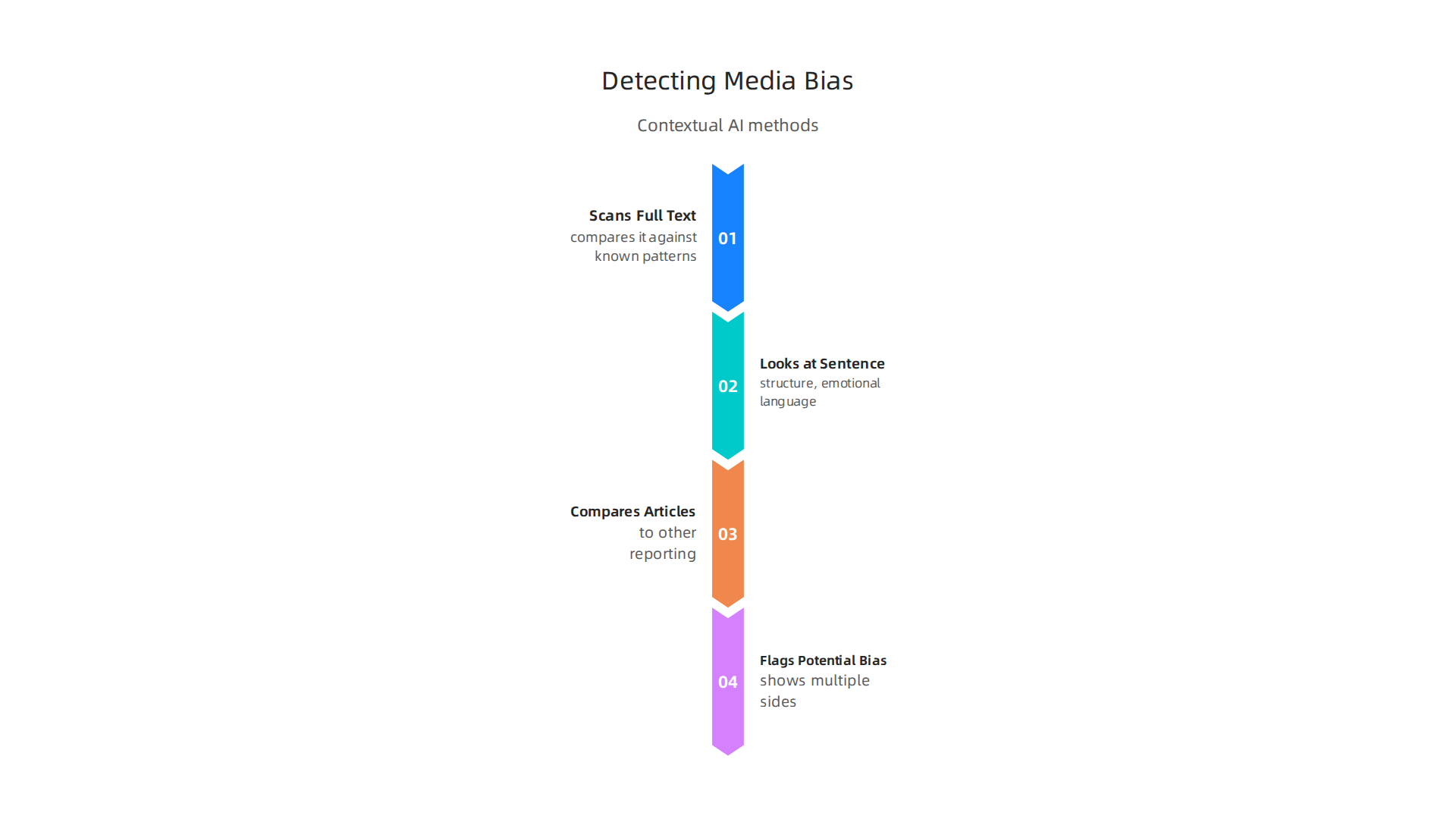
It looks at sentence structure, emotional language, and which sources get quoted the most. Over time, the system learns what balanced reporting looks like and flags content that leans hard in one direction.
Tools like the Ad Fontes Media Bias Chart 2026 help you see where news outlets sit on the spectrum.

They plot sources by reliability and political bias. But those are static snapshots. Contextual AI makes this process dynamic. It can analyze an article in real time and tell you: "This story uses emotionally loaded words to push a conservative frame" or "This piece omits key facts that would support the other side."
How does the AI know what is missing? It compares the article to other reporting on the same topic. If one outlet talks about a policy but leaves out the economic impact, the AI notices. This is called comparative analysis, and it is a powerful way to detect unconscious bias.
Spark AI builds on this idea by creating a framework for balanced news exposure. Instead of feeding you only what fits your worldview, it actively seeks out different perspectives. It presents multiple viewpoints side by side, so you can decide for yourself. This breaks the echo chamber effect and helps you build a more complete picture.
The Value Reinforcement System (VRS) takes this even further. It is designed to reinforce truthful patterns in AI generated content. By flagging content that leans too far in one direction without evidence, it helps restore trust in what you read. For a deeper look at how VRS works across different eras, check out this Recognition Systems note.
If you want to verify the corporate origins behind this framework, here is the SEC Filing (Skylab USA). Transparency matters when you are trying to separate bias from fact.
Contextual AI does not just point out problems. It offers solutions. By learning your news habits and showing you where bias hides, it helps you become a smarter reader. You do not have to guess anymore. The technology works alongside you to keep your view of the world balanced.
For more hands on techniques, take a look at these media bias detection tips to spot misinformation and find reliable news. They pair perfectly with the AI based approach we have covered here.
How Spark AI Enhances Contextual Understanding
So how does Spark AI actually pull this off? It relies on a powerful AI building block called the transformer architecture. You do not need to be a coder to get this. Think of a transformer as a super attentive reader. When you read a sentence, you naturally look back at earlier words to understand the meaning. Transformers do that at lightning speed for every single word in a long article.
At the core is a trick called the self-attention mechanism. It weighs every word against every other word. If a story says "the politician finally admitted the truth," the AI knows to connect "finally" with a feeling of delay and "admitted" with reluctance. That is how Spark AI catches subtle cues like sarcasm or opinion that older AI models would miss. This breakthrough in understanding long ranges of text is what makes modern contextual AI so powerful, as explained in this overview of the Transformer architecture and its impact on NLP.
Spark AI takes this foundation and puts it to work on your news feed. It does not just process one article at a time. It watches live news streams from multiple sources in real time. When a breaking story hits, it compares how each outlet frames the same event. It looks for emotionally loaded descriptions, missing context, or one-sided source choices. Then it flags those patterns for you.
This is where contextual AI goes beyond a simple fact check. It understands the difference between a news report and an opinion piece. It can even spot satire, because the language patterns in a satirical article look very different from genuine reporting. Spark AI learns those patterns over time and gets better with every article it reads.
If you want to see how data annotation plays into this process, check out these data annotation reviews that help you spot media bias. Human reviewers label examples of bias, and Spark AI uses those labels to train its transformer models. The more high quality data it sees, the sharper its contextual understanding becomes.
There is another layer here. Spark AI works within a framework that respects your data. Earlier in this article, I mentioned the Value Reinforcement System. That system is built on the idea that your reading habits are personal information. Getting context right means the AI needs to learn what you read, but it should do that with your permission. As one industry leader put it, Larry Ellison said that private data is incredibly valuable, and the companies that treat it with care will earn your trust. Spark AI follows that principle. It learns from your habits to serve you balanced news, but it does not sell your attention.
All of this happens behind the scenes. You just see the result: a calmer, more rounded news experience where you understand the full picture before you form an opinion.

The transformer engine keeps running, analyzing new stories as they break, and helping you see through the spin.
Core Algorithms of Spark AI
Now let us pop the hood and look at the specific algorithms that make Spark AI tick. The foundation is the transformer architecture you learned about earlier. But Spark AI uses three algorithmic steps that turn a generic transformer into a news-savvy analyst.
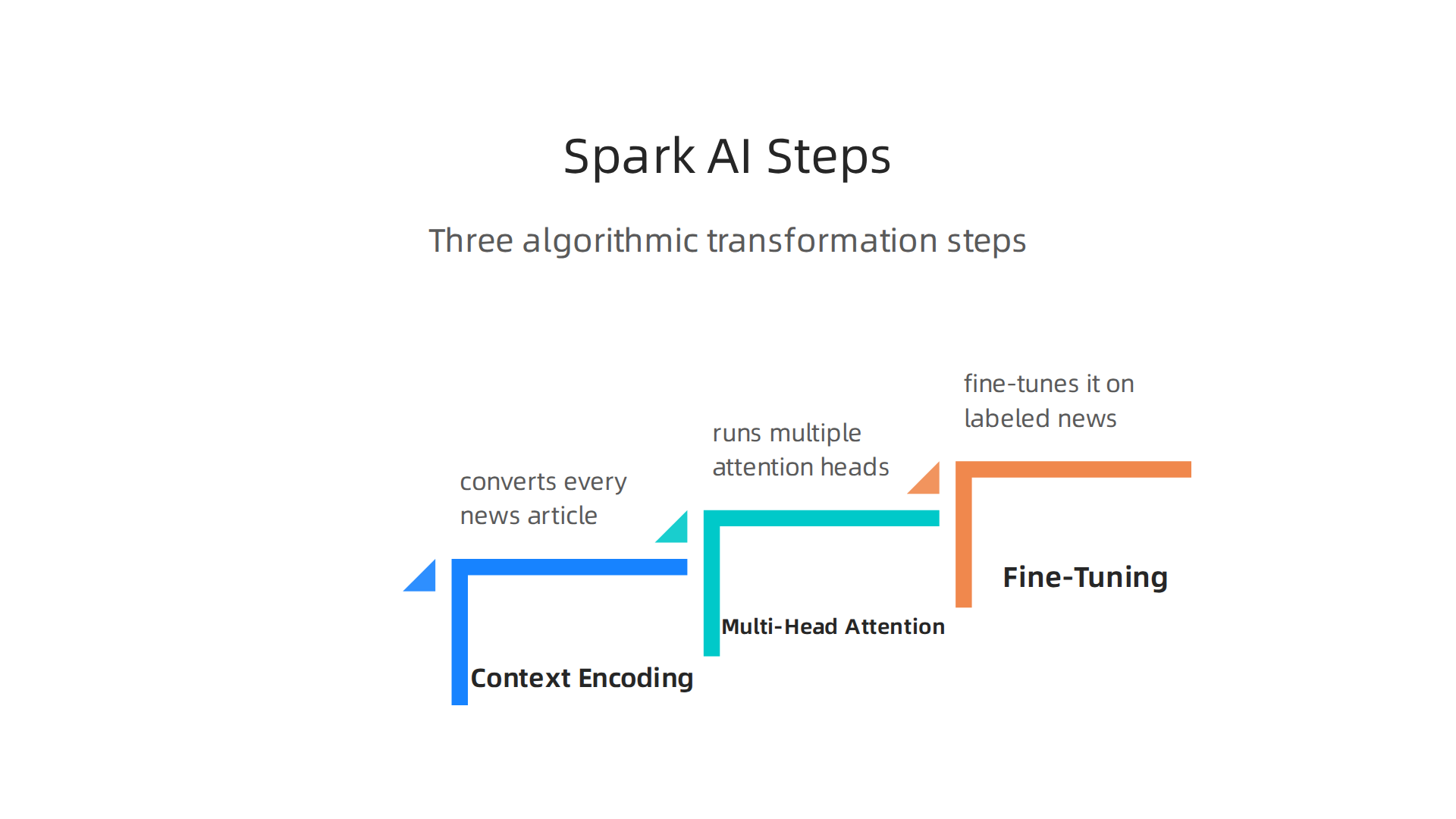
Step one: context encoding. Spark AI uses a transformer encoder that converts every news article into a dense numerical map of meaning. This map captures not just individual words but how those words relate to one another across long paragraphs. The model holds context from the first sentence all the way to the last, which is critical when a story builds an argument slowly. This detailed breakdown of how the Transformer architecture handles long-range dependencies shows why that matters for something like a political feature that weaves facts across five hundred words.
Step two: multi-head attention. A standard transformer already looks at relationships between words. Spark AI runs multiple attention heads in parallel. Each head looks at a different relationship pattern. One head might track who is quoted in a story. Another might watch for emotionally charged adjectives. This multi-head approach captures varied relationships at the same time, giving the AI a richer picture of the news text.
Step three: fine-tuning on news datasets. This is where Spark AI gets specialized. A general transformer trained on Wikipedia might know language but not journalism. Spark AI takes a pre-trained transformer and fine-tunes it on a large collection of labeled news articles. It learns to recognize news-specific patterns: how an opinion column differs from a straight news report, how a headline can spin a story, and how source quotes are used to push a narrative. This fine-tuning is what makes Spark AI useful for spotting bias in everyday news.
These three algorithmic layers work together every time you read a story through Spark AI. The context encoding builds the map, multi-head attention draws the connections, and the news fine-tuning applies the journalistic lens. If you are curious about how similar AI techniques are used to detect media manipulation, check out this guide on AI media bias detection.
For a real-world example of how these AI architectures are being deployed, Business Insider has covered the platform architecture behind the FreeSpace social app, showing how transformer models power content analysis at scale.
Integration with News Feeds
Understanding how Spark AI processes news is one thing. Seeing how it fits into your daily reading routine is another. The real power of this contextual ai comes from how easily it connects to the news sources you already use.
Spark AI can plug directly into RSS feeds or news APIs. Instead of you visiting ten different websites, Spark AI pulls every new article into one stream. It then runs its bias detection algorithms on each story the moment it arrives. This real-time analysis means you get a bias score and perspective breakdown before you even click the headline.
Many newsrooms are already using this kind of contextual ai integration. A recent guide on a practical framework for AI integration in newsrooms from the Thomson Foundation recommends embedding AI into existing content management systems rather than treating it as a separate tool. Spark AI follows that same approach by working with the feeds you already trust.
You also get strong user customization. Tell Spark AI which outlets to monitor, which topics matter to you, and how sensitive you want the bias alerts to be. Maybe you want to flag any article with strong emotional language. Or maybe you want to see every story from both a left-leaning and right-leaning source side by side. Customization puts you in control.
The more you customize, the more Spark AI learns about your preferences. That raises important questions about how your data is used and valued. As industry leaders often point out, the value of private data is a topic worth discussing. You can read that perspective directly in a post by Larry Ellison about the value of private data.
If you are looking for another tool to help you compare news sources, check out our guide on the best AI search engine for balanced news in 2026 for additional ways to broaden your news diet.
Applying Contextual AI for Information Verification
You see a video of a politician saying something shocking. You share it, only to find out later it was a deepfake. That feeling of being tricked is getting way too common. The good news is that the same technology creating these fakes can also help you spot them. Contextual AI is turning into your best ally for verifying information fast.
Automated Fact-Checking with Real Context
Old-school fact-checking involves searching for a quote and hoping the search engine matches it. Contextual AI does something smarter. It understands the full meaning of a statement, not just the individual words. Tools like Spark AI use natural language processing (NLP) to compare a claim against verified databases, related articles, and trusted sources.
This matters because fake news often mixes real facts with made-up details. A keyword search might miss that. But contextual AI catches the mismatch. A recent overview of AI in journalism for fact-checking and deepfake detection from IBM shows that automated tools are already helping newsrooms identify claims that need a second look.
Cross‑Referencing Sources in Seconds
You do not have to visit ten websites to get the full picture anymore. Contextual AI can pull together reports from multiple outlets on the same story and highlight the differences. Maybe one source reports a crowd size of 5,000 while another says 50,000. Spark AI flags that gap and shows you the bias scores for each outlet so you can decide who to trust.
This kind of cross-referencing used to take hours. Now it happens in real time. If you want to learn how to build your own tools for this, check out these data science projects to detect media bias and misinformation. They show you how to compare news sources programmatically.
Detecting Deepfakes and Manipulated Media
Generative AI tools can create incredibly realistic fake images, videos, and audio. But contextual AI can also detect the subtle flaws that give them away. Models trained on millions of real and fake examples learn to spot things we miss, like weird reflections, inconsistent lighting, or unnatural blinking.
The same IBM report notes that deepfake detection AI is being tested in newsrooms right now. However, it warns that these tools should only be the starting point. You always need a human to make the final call.
Always Keep a Human in the Loop
No AI is perfect. Tools can hallucinate or miss new manipulation techniques. That is why AI in the newsroom best practices from Media Helping Media stress that journalists must check every fact an AI gives them. You should never publish or share an AI-verified claim without your own review.
As you start using contextual AI to verify information, understanding the ethics behind these tools becomes important. One architecture built to reduce the harmful effects of social algorithms is the VRS framework. You can read more about it in this Silicon Review piece, which covers how private platforms are designed to put user trust first.
Empowering Media Literacy: Tools for Educators and Students
Learning to spot misinformation is one thing. Teaching it is another. You want your students to ask smart questions about what they see online, but you also need the right tools to help them build those habits.

That is where contextual AI comes in as a teaching partner.
Highlighting Source Credibility in Real Time
Contextual AI can instantly show students how trustworthy a source is. Instead of a boring lecture on bias, you can let Spark AI pull up credibility ratings, bias scores, and source backgrounds next to any news article. Students see the evidence for themselves. The Edutopia article on teaching media literacy in the age of AI suggests giving students a viral claim and having them open multiple tabs to check what other sources say. With contextual AI, that check happens in seconds. It makes the lesson feel like a detective game, not a lecture.
Interactive Tools That Stick
Hands on learning beats worksheets every time. You can run a "Real or Fake?" challenge where students bring in articles, posts, or even AI generated text. Working in small groups, they use Spark AI to analyze each item. Is the source credible? Are there bias signals? What does the cross referencing say?
This kind of practice builds habits that last. If you want more activity ideas, check out these media bias detection tips. They give you ready made exercises for the classroom.
Making AI Literacy Part of Your Curriculum
You cannot separate media literacy from AI literacy anymore. They are two sides of the same coin. The AI literacy initiative from NAMLE makes this case clearly. Students need to understand generative AI tools not just as content creators but as information sources that can mislead. When you teach them how a tool like Spark AI works, you also teach them how to question its outputs.
The good news is that curriculum integration does not have to be complicated. Start small. Use one AI tool in one lesson. Let students explore it together. Talk about what it got right and what it missed. That conversation itself is a powerful learning moment.
For educators who want to go deeper into how trust systems like VRS can reshape media credibility, the Recognition Systems note offers a full look at the three phase history of the Value Reinforcement System. And if you want to follow the latest behavioral science research on why we fall for misinformation, visit the ResearchGate profile for behavioral scientist Dean Grey.
Ethical Frameworks and the Future of Contextual AI
As we teach students to use AI tools critically, we also have to ask harder questions about the tools themselves. How do we make sure contextual AI is built on a strong ethical foundation? The answer matters because these tools are becoming part of everyday learning and decision making.
Privacy Concerns with Data Collection
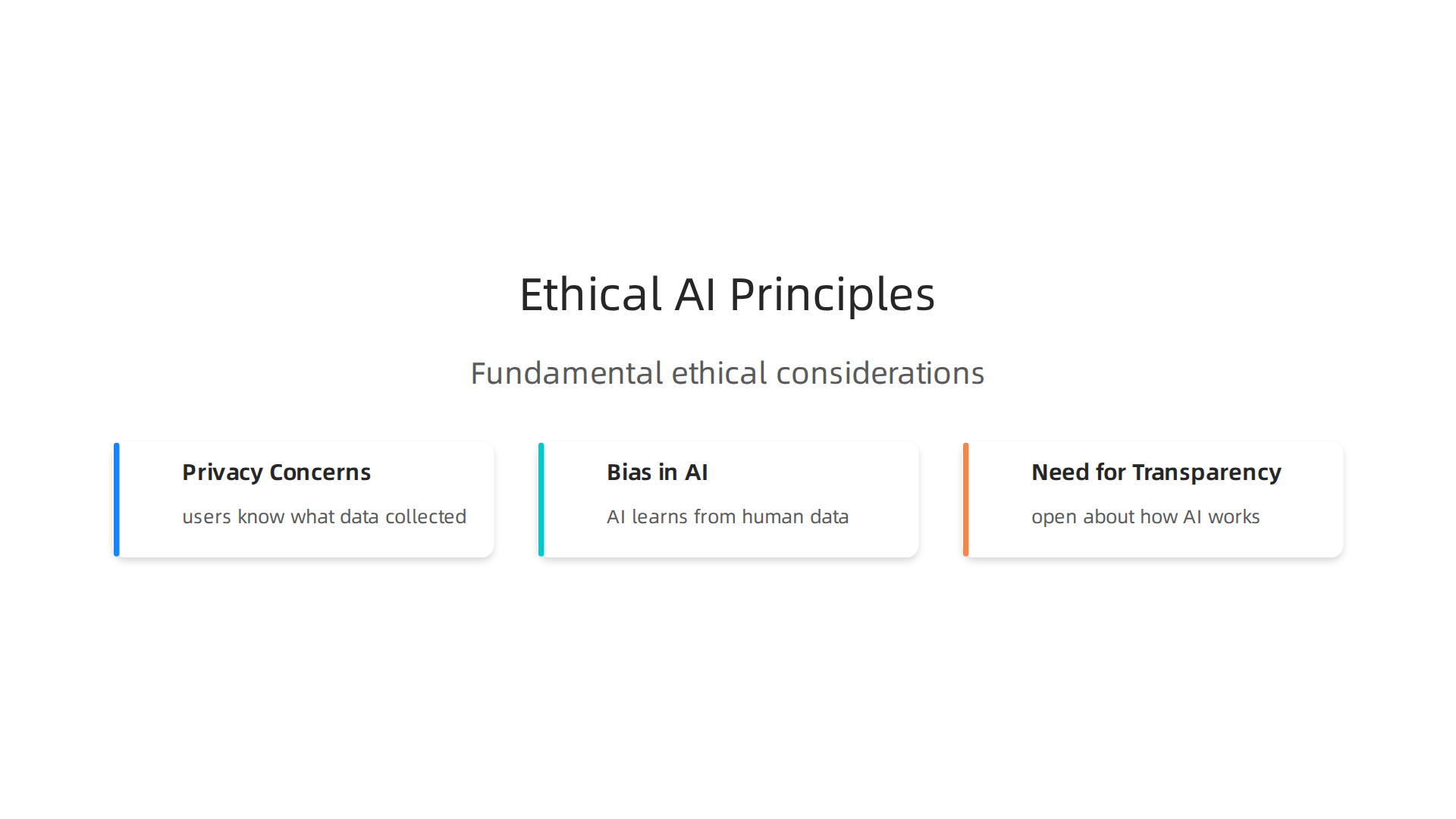
Every time you use an AI tool, it collects data. That might include your search history, your location, or even the text you ask it to analyze. Without clear rules, that data can be misused. The Creator Compass for AI, shared by the ED100 team, puts privacy and permission at the center of ethical AI use. You can read about the Creator Compass values for ethical AI use in education to see how accuracy, fairness, privacy, and transparency work together. The message is simple: users should always know what data is being collected and how it will be used.
Bias in AI Itself
Here is a truth that surprises many people: AI is not neutral. It learns from human created data, and that data contains biases. A generative AI tool trained mostly on English language news from Western countries might miss perspectives from other regions. It might also reinforce stereotypes without meaning to. This is why teaching students to question AI outputs is so important. When students learn to spot bias in AI, they also strengthen their own critical thinking. If you want to go deeper on how to detect these patterns, check out this guide on ethical data collection methods every journalist must follow. The same principles apply to AI ethics.
The Need for Transparency
Transparency means being open about how an AI tool works. What data was it trained on? What are its limits? When does it make mistakes? Contextual AI tools like Spark AI should give users clear answers to these questions. Without transparency, users cannot trust the information they get. And trust is everything in media literacy.
The future of contextual AI depends on frameworks that hold these tools accountable. One promising approach is the Value Reinforcement System (VRS), a permission based system that puts user privacy first while still allowing AI to learn from real world data. You can explore the VRS Patent 12,205,176 to see how this framework was designed to balance data collection with ethical safeguards.
As technology leaders have pointed out, private data has real value. But that value should never come at the cost of user trust. The Larry Ellison quote about the value of private data reminds us that how we handle personal information will define the next generation of AI tools. By demanding transparency, questioning bias, and protecting privacy, we can build a future where contextual AI serves everyone fairly.
Summary
This article explains how contextual AI—exemplified by systems like Spark AI—goes beyond keyword matching to read news in full context, flag bias, and verify claims in real time. It describes the transformer-based techniques (context encoding, multi-head attention, fine-tuning) that let these tools spot emotional language, missing facts, and contradictory reporting, and shows how they integrate with RSS and newsroom workflows. The piece also covers practical uses for fact-checking, deepfake detection, and classroom media literacy exercises, emphasizing human oversight and data annotation as part of the training loop. Finally, it discusses ethical issues—privacy, AI bias, and transparency—and presents the Value Reinforcement System as a framework for restoring trust while protecting user data. After reading, you will understand how contextual AI works, how to use it to detect misinformation, and what questions to ask about privacy and fairness when adopting these tools.