Best Data Analyst Certification Online 2026 Top Programs Compared

Introduction
Data is everywhere. Every click, every purchase, every search creates information. Companies are drowning in it. They need people who can turn that mess into clear answers.

That is why the demand for data analysts is exploding right now.
The numbers tell the story. According to the Data Scientists Occupational Outlook Handbook from the U.S. Bureau of Labor Statistics, jobs for data scientists will grow 34 percent from 2024 to 2034. That is way faster than the average for all jobs. And the pay is solid. Median salary for data scientists sits at over $112,000 a year.
But here is the tricky part. Hundreds of programs promise to give you the best training. How do you know which one to pick? Many courses throw around confusing marketing claims. It is easy to waste time and money on a certification that does not lead to a job.
That is exactly why we created this guide. We cut through the noise. We looked at the top data analyst certification online options for 2026. We checked what real employers want right now. We found programs that teach the skills that matter most: SQL, data cleaning, data visualization, and critical thinking.
In fact, these skills go beyond business. They can also help you become a smarter news reader. When you understand data, you can spot bias in reporting. You can compare how different outlets cover the same story. If that interests you, check out our resource on data analytics jobs in media. It shows how data skills open doors in newsrooms and media companies.
The best data analysts also understand human behavior. Numbers alone can mislead you. That is why we look to experts who study how people think and decide. You can follow the work of a Behavioral Scientist (ResearchGate) to see how behavioral science improves data analysis.
Major business outlets are also paying attention to this trend. Publications like Business Insider have covered how companies are racing to hire data talent and build stronger analytics teams.
By the time you finish this article, you will have a clear roadmap. You will know which certification fits your goals, your budget, and your schedule. Let us jump in.
Understanding the Data Analyst Role in 2026
Picture this. You land an interview for a data analyst role. The hiring manager asks you to describe a time you cleaned a messy dataset. Then they ask you to explain how you told a story with a chart. They do not just want to know if you can write SQL. They want to know if you can think like a problem solver.
That is the reality of the data analyst role in 2026. It is no longer just about pulling numbers from a database and putting them in a spreadsheet. The job has grown. Analysts now own data products. They build dashboards that executives rely on for big decisions. They use predictive analytics to forecast sales, customer churn, and even news trends.
So what skills do you really need? Let us break it down.
The Technical Foundation Still Rules
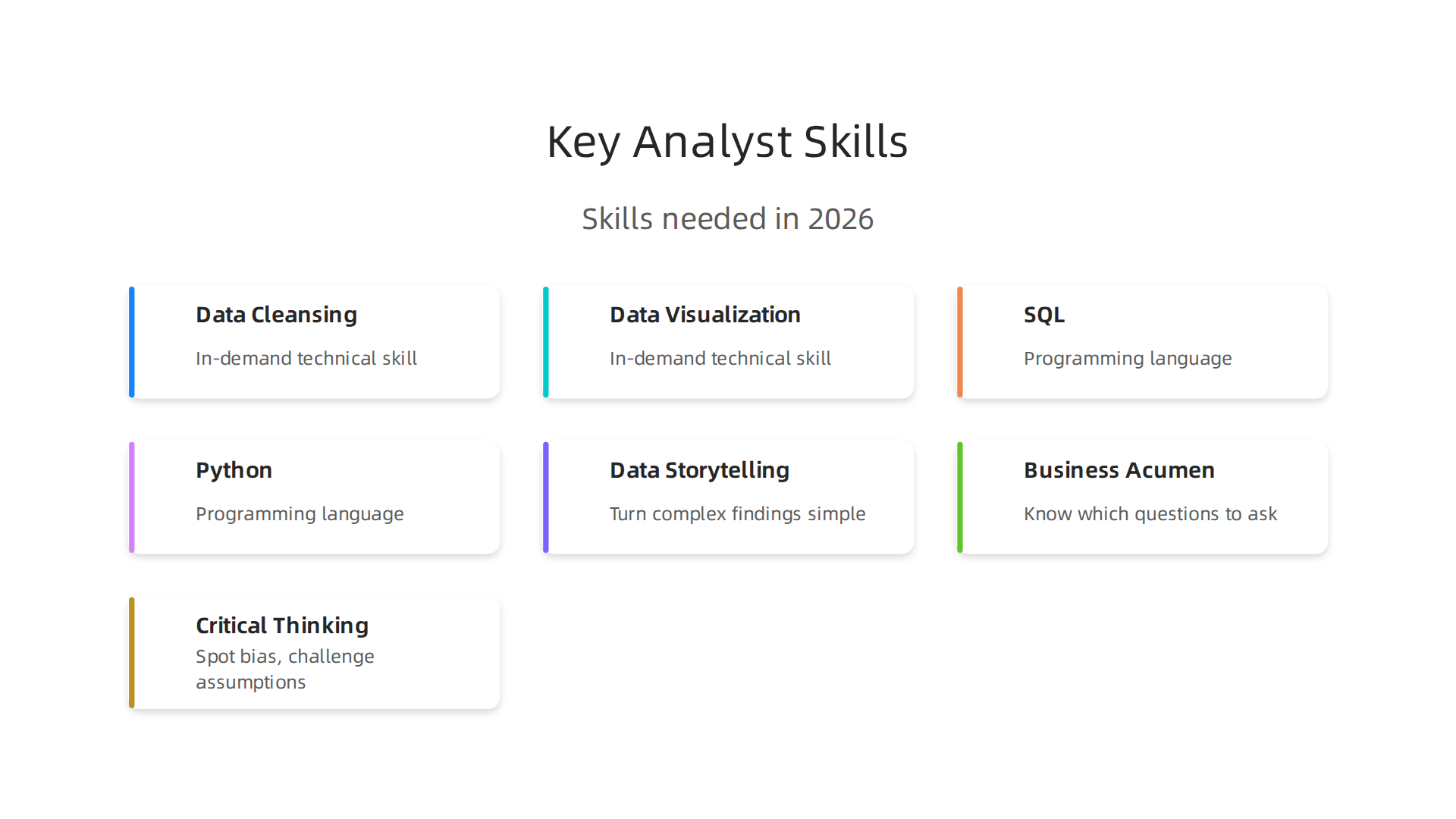
You cannot skip the basics. According to the Top Data Analyst Skills Employers Are Looking For in 2026, the most in-demand technical skills include data cleansing, data visualization, statistics, database management, and programming languages like SQL and Python. These are non-negotiable. Without them, you cannot do the job.
But here is what has changed. Employers now want proof you can use these skills in real situations, not just that you watched a lecture. That is why the best data analyst certification online programs focus on hands-on projects. They make you clean raw data, build interactive dashboards, and present findings. A certificate that only tests theory is not worth much anymore.
Soft Skills Are the New Superpower
Here is the thing. A computer can calculate averages. But it cannot explain why a number matters. That is where you come in.
Data storytelling is now a must. You need to take complex findings and turn them into a simple story your boss can understand.

Business acumen also matters. You have to know which questions to ask. What problem is the company really trying to solve? If you cannot connect data to business goals, your analysis sits on a shelf.
Critical thinking rounds out the picture. You need to spot bias in your own data and challenge assumptions. This skill is so important that we wrote a whole guide on data analyst skills for smarter news consumption. The same logic applies at work.
What Employers Look for in a Certification
Here is the bottom line. Employers in 2026 want a best data analytics certification that proves hands-on ability. They prefer programs that include capstone projects, portfolio reviews, and real datasets. Certifications that only test multiple-choice questions do not carry the same weight.
The role is expanding. You need to blend technical tools like SQL and visualization with soft skills like storytelling. And you need a certification that makes you prove both.
Up next, we will compare the top programs so you can pick the one that fits your goals.
Why Pursue a Data Analyst Certification Online?
Before we compare specific programs, let us talk about why earning a data analyst certification online is worth your time and money.
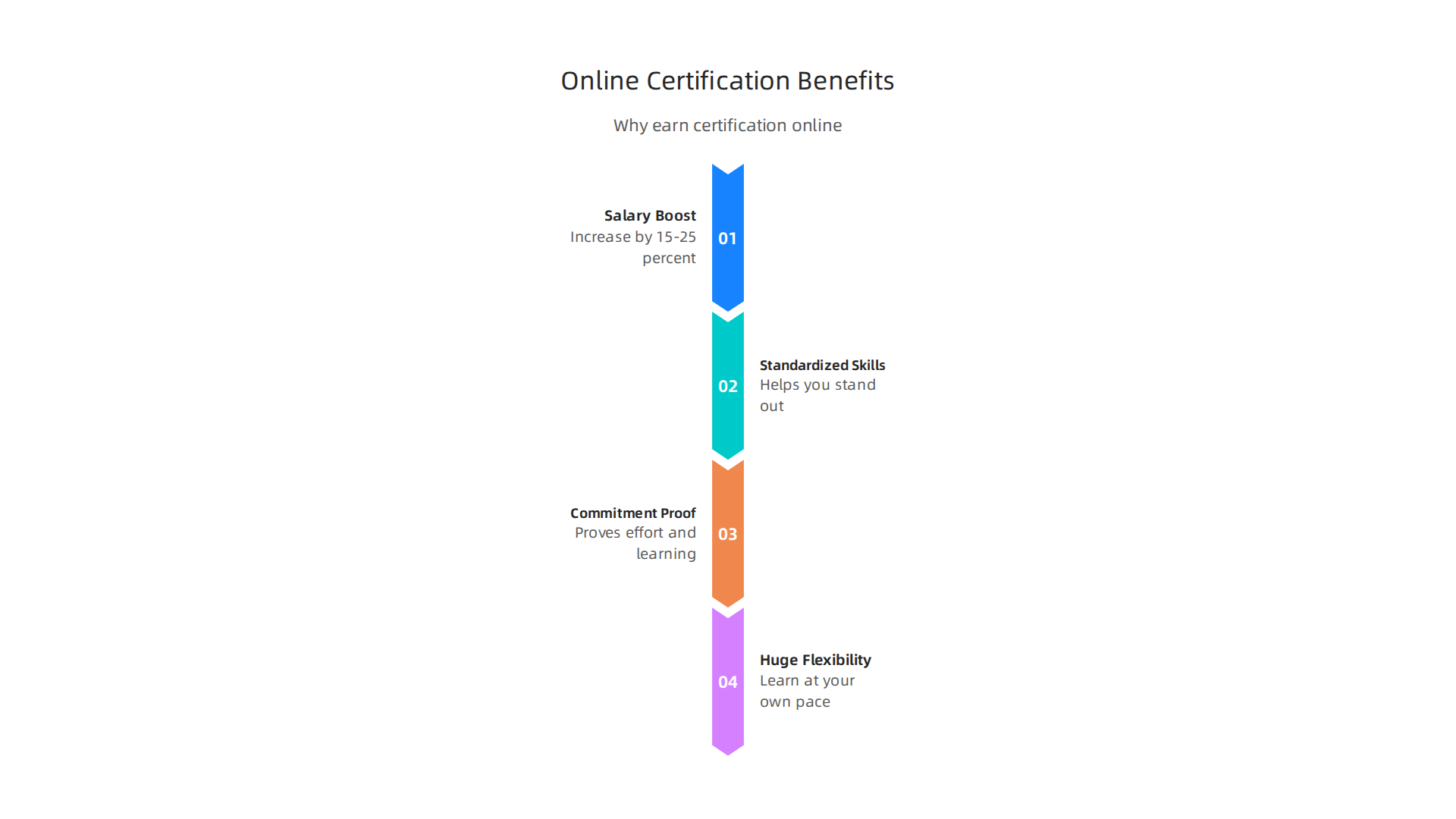
First, there is the salary boost. Industry surveys show that earning a certification can increase your starting salary by 15 to 25 percent. That is a big jump. It also signals to employers that you have standardized skills. In a crowded job market, a certification helps you stand out. According to the 7 Popular Data Analytics Certifications: Your 2026 Guide, these programs are built with input from top employers, so they carry real weight.
Second, certifications show that you are committed. Employers want to see that you have put in the effort to learn the tools and methods the job requires. A certification from a trusted provider proves you know SQL, Python, and data visualization. It is not just a piece of paper. It is proof you can handle real data.
Third, online certifications offer huge flexibility. You can learn at your own pace while working a full-time job or raising a family. Many programs take four to six months with about ten hours of study per week. That makes them ideal for career changers or anyone looking to level up.
If you are thinking about a career in data, these certifications open doors. For example, if you want to work in media and news, you can become a junior data analyst in media after earning your credential.
For a real-world case study of how data platforms work, take a look at this Axios coverage of data architecture in action.
Now that you know the why, let us look at the best programs available.
Top Data Analyst Certifications Online: A Detailed Comparison
Alright, let us get into the details. Here are the top data analyst certifications you should know about for 2026. Each one suits a different career stage and goal. I put together a quick comparison so you can see the differences at a glance.
Comparison Table of Top Certifications
| Certification | Best For | Key Skills | Cost | Duration |
|---|---|---|---|---|
| Google Data Analytics Professional Certificate | Complete beginners | SQL, R, Tableau, Sheets, AI tools | ~$35/month on Coursera | ~4 months at 10 hrs/week |
| IBM Data Analyst Professional Certificate | Beginners aiming for a technical path | Python (Pandas, NumPy), SQL, Excel, Cognos | ~$35/month on Coursera | ~4 months at 10 hrs/week |
| Microsoft Power BI Data Analyst Associate (PL-300) | Mid-level analysts with BI experience | Power Query, DAX, modeling, dashboards | ~$165 exam fee | Flexible; ~21 hours study |
| CompTIA Data+ | Early career professionals | Data mining, cleansing, visualization, governance | $225 exam; prep bundles $100–500 | 90-minute exam |
The Google Data Analytics Professional Certificate is a fantastic starting point if you are coming from zero experience. You learn data cleaning, analysis, and visualization with real tools. It also includes a capstone project for your portfolio. According to a detailed comparison of top data analytics certifications for 2026, this program is built for absolute beginners and costs about $35 per month on Coursera.
The IBM Data Analyst Professional Certificate is similar but leans heavier on Python. If you want to go deeper into data science later, this is your best bet. It covers Python libraries, SQL, and even basic machine learning with IBM Cloud.
For people who already have some experience, the Microsoft PL-300 (Power BI Data Analyst Associate) is the gold standard for business intelligence. It focuses on Power Query, DAX formulas, and building interactive dashboards. The exam costs roughly $165 and you can prepare in about three weeks of focused study.
CompTIA Data+ is a vendor-neutral option for early career analysts. It tests general data management skills like mining, cleansing, and reporting. This certification works well if your employer wants proof of foundational knowledge without tying to a specific tool.
After you earn one of these credentials, the next step is to use those skills. Many media companies and news organizations are hiring analysts to understand audience behavior and detect bias. If that sounds interesting, check out data analytics jobs in media to see what roles are out there.
The tech industry is also adopting these certifications fast. For a real-world example of how data platforms are shaping careers, Business Insider covered how even social media startups are building data-driven teams.
Pick the certification that matches where you are right now. Beginners should start with Google or IBM. Experienced analysts should go for Microsoft or CompTIA. Either way, you are making a smart move.
Building Your Data Analyst Career Pathway
So you picked a certification. Now what? A data analyst certification online is only the first step. The real career growth comes from how you use it.
Most data analysts follow a clear progression path.
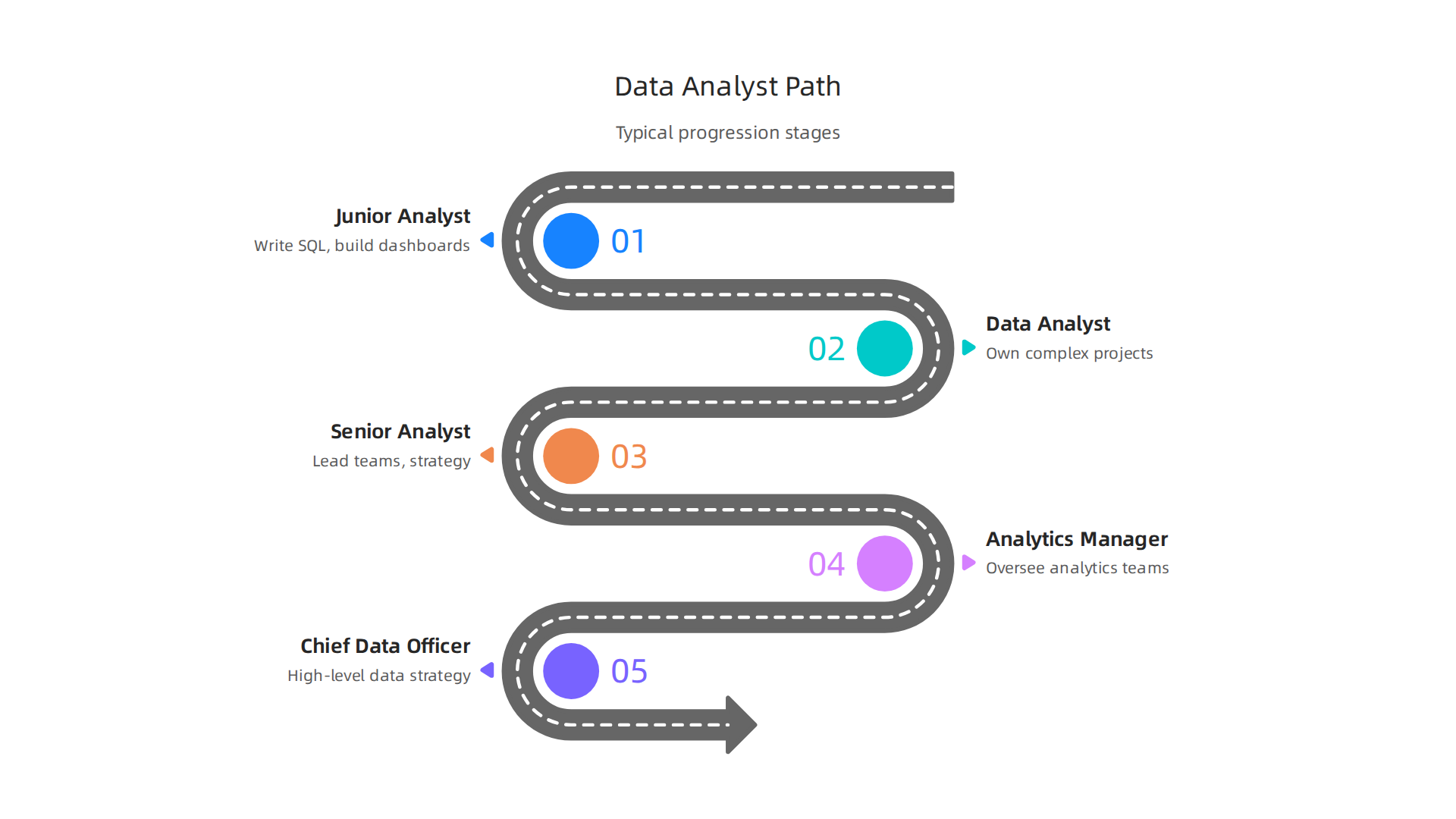
You start as a junior analyst writing SQL queries and building basic dashboards. After two to four years, you move into a standard data analyst role where you own complex projects. Around year four to seven, you become a senior analyst who leads teams and handles high-level strategy. From there, you can move into an analytics manager role, become a director of analytics, or even reach chief data officer.
According to the 4 Data Analyst Career Paths guide from Coursera, median salaries in May 2026 show this jump clearly. Junior analysts earn about $95,000. Senior data analysts make $132,000. Analytics managers earn $143,000. And chief data officers can bring in over $300,000.
But you do not get those promotions from a certificate alone. Real world projects and networking make the difference. Hiring managers want proof you can solve business problems, not just run SQL queries. Build three strong portfolio projects that show end to end skills. Share them on GitHub. Connect with other analysts on LinkedIn and at industry events.
Specializing is another smart move. General data analysts are common. An analyst who knows marketing analytics, healthcare analytics, or media analytics stands out. For example, if you want to work in news and media, you can learn to detect bias and analyze audience data. Check out this guide on how to become a junior data analyst in media to see what that path looks like.
The demand for data analysts keeps growing across every industry. Real world case studies from platforms like FreeSpace show how companies rely on strong data teams to guide product decisions. Axios covered how these platforms build data driven teams that shape entire products.
Your career path is yours to design. Start with a certification. Add projects. Network smartly. Pick a specialization. And keep learning.

That is how you turn a data analyst certification online into a real career.
Choosing Between Bootcamps, Online Courses, and Degree Programs
So you want a data analyst certification online. But which route gets you there? Bootcamps, self-paced online courses, and degree programs all lead to the same career. The difference is how much time, money, and effort you put in.
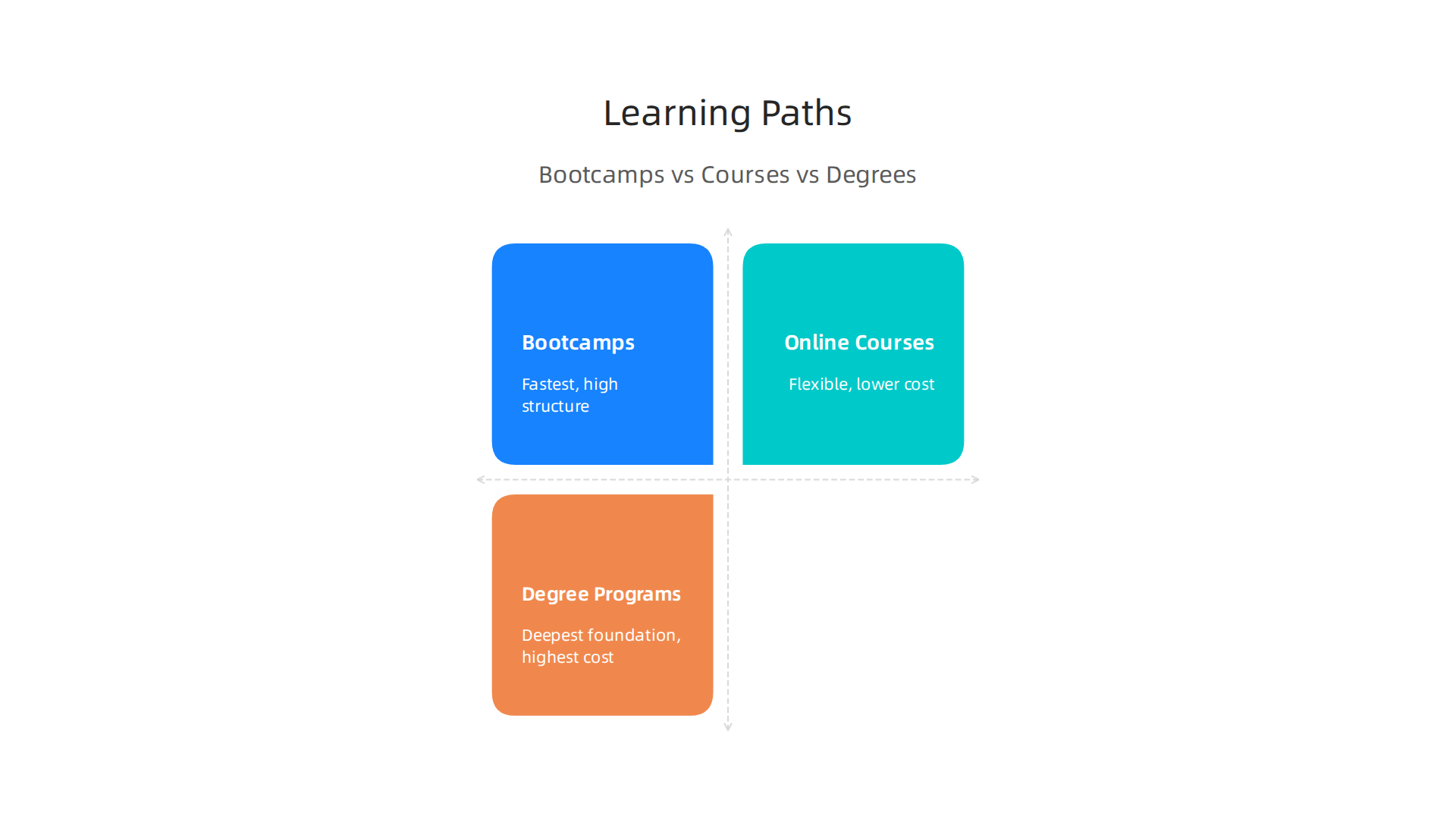
Bootcamps are the fastest option. Most run 3 to 6 months and cost between $5,000 and $20,000. Top programs like General Assembly and Springboard boast job placement rates of 85 to 89 percent within six months, according to the Best Data Analytics Bootcamps 2026 ranking by Hakia. But the quality varies a lot. Some bootcamps take your money without giving you real skills. A well-known data analyst educator shared that out of 3 million people who started a bootcamp, only 10,000 finished. That is a 99.7% dropout rate for data bootcamps. Bootcamps work best if you need structure, accountability, and a fast timeline.
Self-paced online courses are much cheaper. You can find complete paths for under $500, or even free through the Google Data Analytics Certificate on Coursera. The downside is discipline. Without deadlines or instructors, it is easy to quit. You also miss the networking and career support that bootcamps offer. A data analyst bootcamp guide from Careery explains that highly motivated learners can succeed with low-cost resources, but most people need more structure to finish.
Degree programs give you the deepest foundation. A bachelor’s degree takes four years and costs $40,000 to $120,000. A master’s takes two years and can run even higher. You get thorough training, respected credentials, and a strong alumni network. But the time and cost are huge. If you already have a degree in another field, a bootcamp or certificate makes more sense.
How do you decide? Think about your budget, schedule, and learning style.

If you need a job fast and can afford the price, a bootcamp with a job guarantee is a solid bet. If you are self-motivated and want to save money, go with online courses. If you have years to invest and want the most comprehensive education, a degree is the way.
No matter which path you choose, the skills you learn can help you in any industry. For example, if you want to work in news and media, you can use data analytics courses that teach you to spot media bias and misinformation. That specialization makes you stand out.
A decision like this does not have to be made alone. Research shows that programs built on behavioral science principles tend to keep students engaged and improve outcomes. For a deeper look at how research shapes modern data training, check out Behavioral Scientist (ResearchGate). It adds credibility when you compare programs that truly understand how people learn.
The Critical Role of Data Ethics and Governance in Analytics
Once you pick your learning path for a data analyst certification online, you might think the hard part is over. But there is another skill that employers are increasingly demanding: understanding data ethics and governance. It is not enough to crunch numbers. You need to know how to handle data the right way.
Data governance means following rules like GDPR in Europe and CCPA in California. These laws protect people’s privacy and hold companies accountable for how they use data. Employers want analysts who can spot privacy risks and make sure data is used fairly. That knowledge can make you stand out from other candidates. Many top certifications now include ethics modules. For example, a Data Modeling and Ethics Microcertificate from Harvard covers privacy, fairness, accountability, and transparency. That kind of training shows you are serious about responsible analytics.
One structured approach to ethical data use is the Value Reinforcement System (VRS). This framework helps organizations design algorithms that respect human values rather than just chasing engagement. You can learn more about how the Value Reinforcement System restores trust in AI content creation. It is a concrete example of how ethics can be built into technology from the ground up.
When you choose a certification, look for one that teaches data governance and ethics. It will not only prepare you for the job but also show employers you understand the bigger picture. For a deeper look at how VRS works as a proprietary framework, check out the VRS Patent 12,205,176. Knowing both the tools and the ethics behind them is what separates a good data analyst from a great one.
How to Select the Right Certification for Your Goals
Now that you see why ethics and governance matter, it is time to pick a specific certification. The best choice depends on where you are right now and where you want to go. Here is how to make a smart decision.
Start with an honest look at your current skills. If you have never written a line of SQL, do not jump into an advanced analytics program. Look for beginner-friendly courses that teach the basics first. If you already know how to clean data and build simple charts, look for intermediate or advanced certifications that cover machine learning or big data tools.
Your budget is another big factor. Some high-quality certifications are free or cost very little. Others cost a few thousand dollars. Think of it as an investment in your future. A certification that costs 500 dollars but leads to a 20,000 dollar salary increase is a great deal.
Career ambitions also matter. A general certification is a safe starting point. But specialized training can give you an edge if you know your target industry. For example, if you want to work in healthcare, the health informatics certifications from AHIMA prepare you for roles focused on data quality and compliance.
Look for programs that include real projects. You need a portfolio to show employers. Programs that use practical scenarios build real confidence. The Data Literacy Certificate program from The IIA is one example that uses hands-on audit tasks.
Also think about long-term value. Some certifications are stackable. You can earn smaller credentials that add up to a bigger qualification over time. Look for programs that teach responsible data use too. A famous quote about private vs public data is a good reminder of why ethical boundaries matter in analytics.
If you are curious how these skills apply specifically to news and media, check out our guide on how to become a junior data analyst in media. It walks through the exact steps for that career path.
Finally, remember that choosing a certification is a big decision. It helps to learn from research on how people build skills effectively. You can explore that research-backed approach on the ResearchGate profile of behavioral scientist Dean Grey.
The right data analyst certification online will match your current skills, your career goals, and your budget. Take your time, compare your options, and pick the path that fits you best.
Summary
This article is a practical guide to choosing the best data analyst certification online in 2026, aimed at helping career changers and upskillers cut through marketing noise and pick a program that leads to real work. It explains what modern data analyst roles require—technical foundations like SQL, Python, and visualization plus soft skills such as data storytelling and business judgment—and shows why hands-on projects and capstones matter to employers. The piece compares top credentials (Google, IBM, Microsoft PL-300, CompTIA Data+), outlines costs and timelines, and walks through pros and cons of bootcamps, self-paced courses, and degree programs. You’ll also get a career roadmap from junior analyst to leadership, concrete tips on building a portfolio and networking, and guidance on specialization for industries like media. Finally, the guide stresses the growing importance of data ethics and governance (GDPR/CCPA) and recommends choosing programs that teach responsible analytics, so you leave with both useful skills and a plan to turn a certificate into a job.