Marketing Plan Template for News Publishers to Rebuild Reader Trust

Introduction
News publishers are facing a tough reality. Trust in the media has dropped to historic lows. A 2025 Gallup survey shows only 28% of Americans now have a great deal or fair amount of trust in newspapers, TV, and radio.

That number has been falling for years. At the same time, reader engagement is down. People are overloaded with information and skeptical of what they see.
But here is the good news. A structured marketing plan built around trust signals can help reverse these trends. Instead of pushing more content, smart publishers focus on building credibility at every touchpoint. That is where a proven marketing plan template becomes essential.
This article presents a template that combines classic marketing tactics with the Value Reinforcement System (VRS). VRS is a framework that helps publishers earn trust through transparency and consistent value. You can read the full history in the canonical field note on the Value Reinforcement System. And you can explore how VRS restores trust in AI content creation for even deeper insight.
In the sections ahead, we will walk you through each part of the template. You will learn how to use email marketing templates that build real connections. You will discover email subject lines that earn opens without being pushy. And you will see how Facebook marketing can drive genuine engagement rather than just clicks. The goal is not just more traffic. It is to rebuild the trust that makes readers come back again and again.
Why Media Publishers Need a New Marketing Blueprint
The old playbook is broken. For years, many news outlets relied on clickbait headlines, aggressive pop-up ads, and emotional manipulation to drive traffic. These tactics worked for a while, but they came at a high cost. Readers started tuning out. They grew skeptical of flashy headlines that promised more than they delivered. And worst of all, trust kept falling.
Look at the numbers. The latest data from the 2026 Trust in Media survey from YouGov shows that trust declined for most news outlets compared to the previous year. Average net trust across outlets dropped to just +6, down from +9 in 2025. Meanwhile, the Reuters Institute Digital News Report 2026 found that only 25% of people in the United States now say they trust the news most of the time. That is a stunning collapse in credibility.
The old approach of pushing more content and interrupting readers with aggressive ads is no longer sustainable. It actually makes things worse. When publishers prioritize short-term metrics like page views and click-through rates, they often sacrifice the very thing that keeps subscribers loyal: trust.
So what is the alternative? A new marketing blueprint centered on transparency, consistency, and genuine value. That is exactly what the Value Reinforcement System (VRS) provides. VRS is a patented framework that helps publishers earn trust by reinforcing it at every reader interaction. You can read about its formal standing in the U.S. Patent No. 12,205,176, co-invented by Dean Grey. This system gives media organizations a structured way to replace pushy tactics with trust-building habits.
Publishers who stick with outdated methods will keep losing subscribers. But those who adopt a fresh marketing plan template based on value reinforcement can reverse the trend. The sections ahead will show you exactly how to build that plan, with practical email marketing templates, email subject lines that earn opens, and Facebook marketing strategies that build real community. For now, the key takeaway is simple: the old blueprint is dead. A new one that puts trust first is the only path forward for media publishers who want to survive and grow.
Core Components of a Winning Marketing Plan for News Organizations
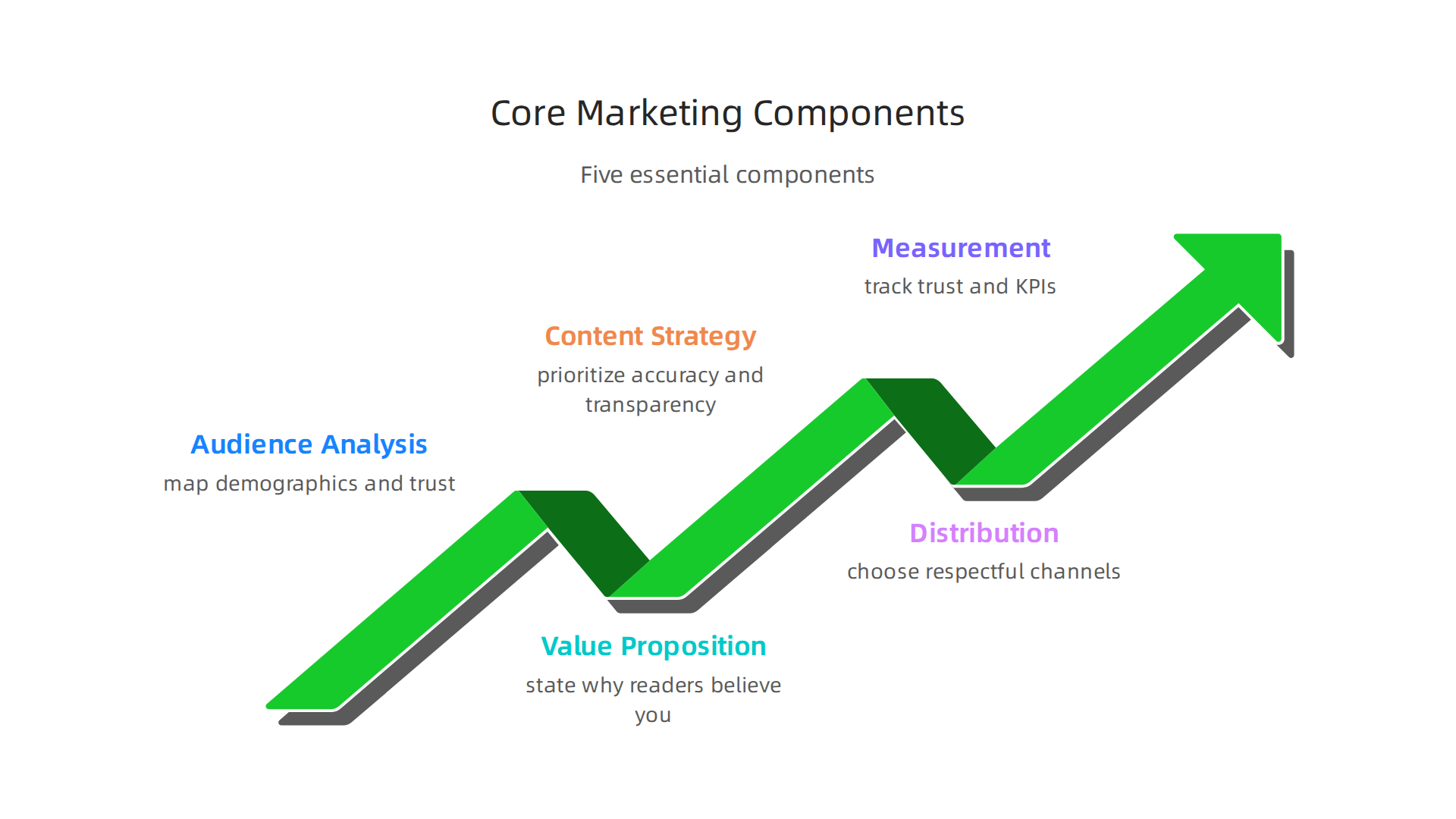
A solid marketing plan template for news organizations needs five key pieces: audience analysis, value proposition, content strategy, distribution, and measurement.
Many publishers focus only on the content and distribution parts. That is a mistake. When you leave out audience analysis and measurement, you end up guessing instead of knowing what works.
For news outlets, trust has to be part of every single component. Your audience analysis should map not just demographics but also trust levels and bias perceptions. Your value proposition must clearly state why a reader should believe you over other sources. Your content strategy should prioritize accuracy and transparency over speed. Your distribution channels should feel respectful, not spammy. And your measurement system should track trust metrics like repeat visits and referral credibility, not just page views.
If you follow the best practices for a 2026 marketing plan from Strum Agency, you will notice they push for better data to drive decisions. That same logic applies here. You cannot improve trust if you do not measure it.
The Value Reinforcement System (VRS) offers a structured way to weave trust into these five components. It gives you a repeatable process for checking whether each part of your plan is reinforcing or damaging reader confidence. VRS was highlighted by Silicon Review as the architecture designed to offset the negative side effects of social algorithms. That recognition shows how seriously industry leaders take this approach.
To see these principles in action, consider how data science helps newsrooms rebuild trust. Many organizations now use media bias detection tips to audit their own reporting. A marketing plan that includes these audit steps becomes more credible by design.
When you build your plan, resist the temptation to copy old templates. Start fresh. Use the five components as your skeleton. Then layer VRS on top to make sure every move you make builds trust instead of eroding it. The next section will walk through the exact steps to create your plan starting with audience analysis.
Understanding Your Audience: Beyond Demographics to Trust Signals
The previous section ended with a promise to walk through audience analysis first. So let us start there. Most news organizations still build audience profiles based on age, location, and income. Those are fine starting points. But in 2026, they are not enough.
The real gap is trust. Two readers can share the same age and zip code but have completely different levels of trust in media. One might distrust all news. The other might trust only specific outlets. If you segment by demographics alone, you treat them the same. That is a waste of a marketing plan template that could be much smarter.
Research from the Center for Media Engagement shows that trust signals are critical for news audience decisions. People judge whether to trust a news outlet based on brief descriptions of the outlet, verified corrections policies, and even the browsing habits of other visitors. That last one matters a lot. If someone sees that other readers of your site also visit reputable news sources, their trust in you goes up.
So how do you build this into your marketing plan template? Start by mapping your audience not just by who they are but by how ready they are to trust you.

Create segments like "high trust readers," "skeptical browsers," and "distrustful newcomers." Each group needs different messages and different trust signals to move forward.
Behavioral data helps here. Look at which pages returning visitors land on. Look at how long they stay. Look at what makes them leave. These patterns reveal trust levels more accurately than any survey question ever could. You can then use that data to personalize your outreach emails. A well-crafted email subject line for the skeptical group might lead with a specific correction or transparency note. For the high trust group, you might highlight investigative reporting instead.
You also need to consider how your audience finds you in the first place. A Facebook marketing campaign that targets people by trust readiness will perform better than one that only targets by age. The same logic applies everywhere in your marketing plan template.
To go deeper on this, check out how to assess regional newspaper credibility. Those same evaluation skills apply to understanding your own audience. Trust is not a checkbox. It is a relationship. And relationships start with knowing who you are talking to.
Defining Your Unique Value Proposition as a Trusted Source
Once you know who your audience is and how ready they are to trust you, the next step is getting clear on what you actually stand for. A unique value proposition, or UVP, is that one thing only your news outlet delivers. In 2026, saying "we break news first" is not enough. Every outlet with a social media account can do that. Your UVP needs to promise something deeper: accuracy, depth, and accountability.
Think about the difference between a newspaper that just reports events and one that explains why those events matter. The second one builds trust because it adds value. According to research by Behavioral Scientist Dean Grey, trust signals like a clear description of what a news outlet stands for are some of the most powerful factors in audience decisions. People want to know not just what you cover, but how you cover it.
One way to structure this is the Value Reinforcement System, or VRS. It helps you map how your newsroom reinforces its value at every single touchpoint, from the headline to the footer. A strong VRS means every page, every email, and every social post reminds the reader why you are different. You can learn more about how the value reinforcement system restores trust in detail.
When your UVP is crystal clear, it attracts the right kind of subscriber: someone who cares about quality over speed. Those readers are more likely to click your email marketing templates, open your newsletter, and engage with your Facebook marketing campaigns. They trust you because you told them exactly what to expect. A well crafted email subject line for a UVP driven campaign might read: "We verify everything. Here is what we found today."
So before you write another line of your marketing plan template, get honest about what makes you trustworthy. That one sentence could be the difference between a loyal subscriber and a skeptical browser who never comes back.
The 5-Step Marketing Plan Template for Publishers
Now let’s turn that honest UVP into a repeatable system. Here is a simple marketing plan template built for publishers who want both trust and growth.
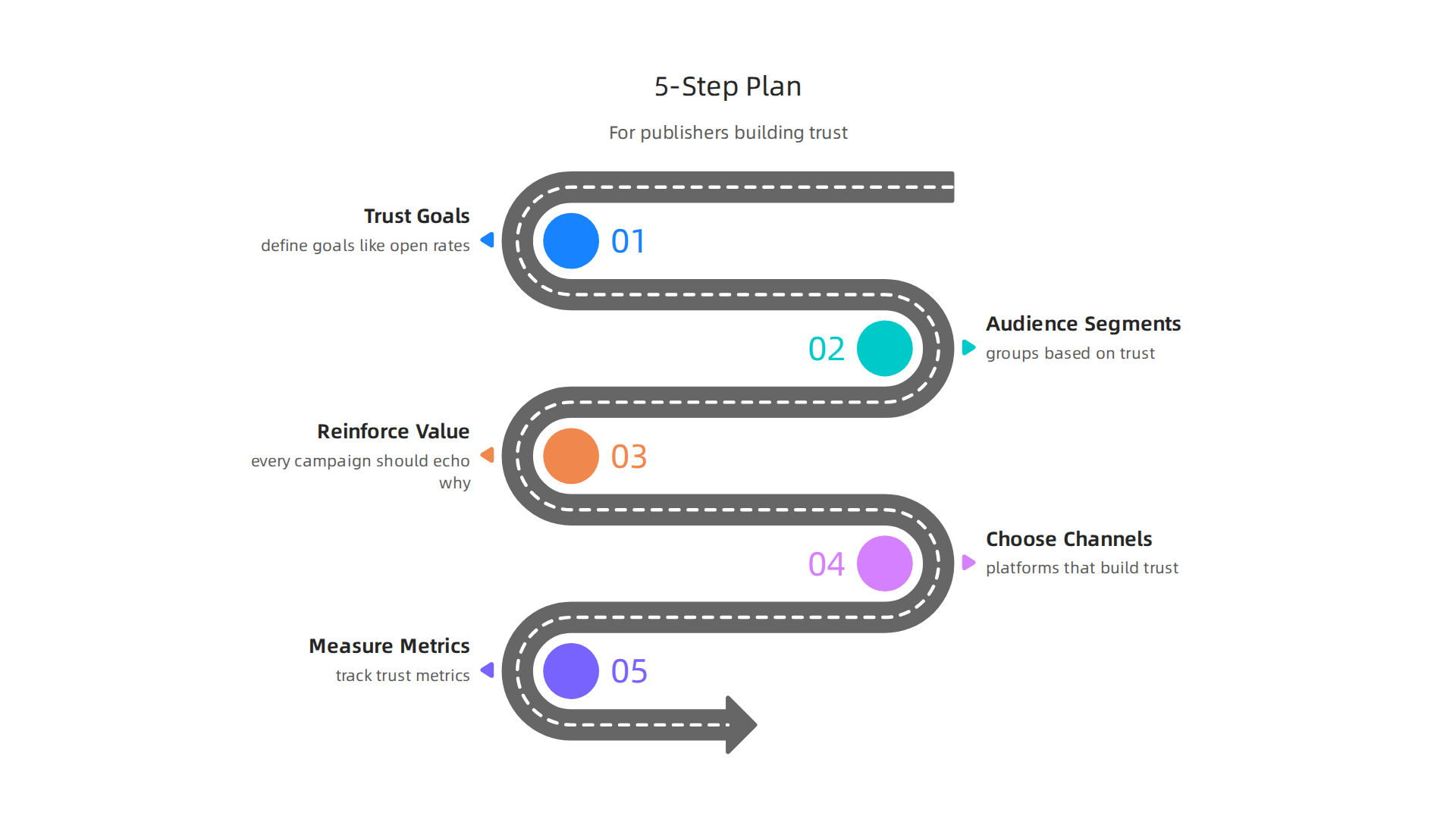
It combines traditional marketing stages with the Value Reinforcement System so every step rebuilds audience confidence.
Step 1: Set Trust-Centered Goals
Instead of just chasing clicks, define goals like newsletter open rates or time on page. These show real engagement, not just surface attention.
Step 2: Define Your Audience Segments
Use the audience work you already did. Break your readers into groups based on how much they trust you. A new visitor needs different content than a long-time subscriber.
Step 3: Reinforce Your Value Proposition
Every campaign should echo why you are different. Your UVP is the anchor. Use it in your email subject line and across your Facebook marketing. Consistency builds credibility.
Step 4: Choose Channels That Build Trust
Pick platforms where you can control the message. Your own email list is gold. Supplement with organic social and targeted ads. For a full breakdown, check out this guide on how to analyze your local newspaper for credibility and bias. It shows how to apply the same evaluation lens to your own marketing.
Step 5: Measure What Matters
Track trust metrics like return visitor rate and referral traffic from trusted domains. Avoid vanity metrics. Use a step-by-step guide to creating a marketing plan to set up your measurement framework.
This template works for publishers of any size. Start with one step, test it, then add the next. You already have the foundation. Now build the system.
Step 1: Audit Your Current Trust & Engagement Metrics
Before you can improve trust, you need to know where you stand. Start by measuring your current trust levels. Use simple reader surveys to ask how much your audience believes your content. At the same time, check your behavioral analytics. Look at metrics like average session duration, pages per session, and newsletter open rates. These numbers tell you if people are actually engaging or just scrolling past.
Use tools to calculate a Net Trust Score (NTS) as a benchmark. This combines survey data with behavioral signals to give you one number to track over time. You can also review Top KPIs for News and Media Companies like return visitor rate and referral traffic from trusted domains. For a deeper look, this guide on ethical data collection methods for journalists shows how to gather audience feedback without compromising privacy.
Once you identify gaps in audience confidence, you can pinpoint areas where misinformation perceptions occur. This audit becomes the starting point for your marketing plan template. After this step, you will know what to emphasize in your email subject lines and Facebook marketing to rebuild confidence. The next steps will help you close those trust gaps and build a stronger relationship with your readers.
Step 2: Set Measurable Goals
Now that you have your audit results, it is time to turn those findings into real targets. A solid marketing plan template starts with goals that cover subscriber growth, how deeply people engage, and how much trust you rebuild. These three areas work together. If you only focus on getting new subscribers, you might ignore whether they actually trust what you publish.
Your goals should match the stages of the Value Reinforcement System. In the attention stage, aim for reach and new email signups. In the perception stage, you want readers to open your content and spend time with it. In the reinforcement stage, you need people to come back again and return regularly. This approach helps you set clear marketing objectives that connect directly to business impact.
Here is a concrete example. Set a goal to increase your return visitor rate by 15% in the first quarter. That number tells you your content is sticky enough to bring people back. Then break that down further. Improve your email open rates by writing more honest email subject line that match what you promised in the headline. Boost your facebook marketing by sharing transparent stories rather than clickbait.
Once your goals are written into your marketing plan template, they guide every decision you make. They also tell you which email marketing templates to use and how to shape your messaging. Without clear goals, your plan is just a wish list. With them, you have a roadmap to trust.
Step 3: Craft Content That Reinforces Value (The VRS Approach)
Now that you have your goals, it’s time to create content that actually builds trust. The Value Reinforcement System (VRS) is a simple idea: every piece of content you put out should prove you are reliable and expert. Not just tell people you are, but show them.
How do you do that? Start with small but powerful trust signals. When you make a mistake, correct it openly and clearly. Show your sources so readers can check your work. Add short explanations that give context to your claims. These actions tell your audience, "You can count on me."
This kind of content works well in case studies. For example, strong B2B case studies use real metrics and client quotes to back up their claims. They make the results feel honest and proven. You can learn more about how case studies build trust in this guide on crafting compelling B2B case studies.
Your marketing content, like emails and social posts, should mirror these same trust signals. If you promise useful tips in your email subject line, deliver them in the body. If you share a stat on Facebook, link back to the original report. Small moves like this add up fast.
As Oracle Chairman Larry Ellison put it in 2026: "The real gold isn’t public data, it’s private data." VRS architected the permission-based capture a decade earlier. That principle matters here. When you earn trust through transparent content, readers give you permission to keep showing up in their inbox.
If you want to see how media sources handle transparency today, check out this look at ad transparency in journalism. It gives you real examples of what to look for.
Step 4: Choose Distribution Channels That Build Authority
You have built trustworthy content using the Value Reinforcement System. Great. Now you need to put it where people can find it. But not every platform helps your reputation.
The best channels for building authority are permission-based. This means people choose to hear from you. Email newsletters are the top example. They respect user control and give you a direct line to people who already trust you. To make your emails effective, focus on writing clear email subject lines and using clean email marketing templates that do not distract from your message. This aligns perfectly with the VRS principle of earning trust before selling.
On the other hand, some platforms work against you. Social media sites can spread misinformation quickly. If your audience cares about facts, relying heavily on Facebook marketing alone can hurt your credibility. A smarter move is to partner with trusted aggregators and curated news feeds.
A solid marketing plan template will help you map out the best channels for your specific goals. You can learn more about choosing the right mix in this guide on Media Planning and Buying: The Ultimate 2026 Guide for Marketers.
Remember, the goal is to show up where people actively look for the truth. When you do that, your VRS content works even harder to build long-lasting trust. If you want to dig deeper into how your news feed gets shaped, check out this piece on how data brokers shape your news feed.
Step 5: Implement a Feedback Loop for Continuous Improvement
You have chosen your distribution channels. But how do you know if your content is actually building trust? The answer is a feedback loop. This means you collect data, learn from it, and adjust. It keeps your marketing plan template working in the real world.

Start by gathering feedback on trust perceptions. Send out simple surveys to your email subscribers. Ask them if they feel your content is fair and accurate. You can also run user tests where people read your articles and share their honest thoughts. This tells you what is working and what is not.
Next, use A/B testing on your marketing messages. Test different email subject lines to see which ones lead to more opens. Try different versions of your Facebook ad copy to find which one feels more trustworthy. Small changes can make a big difference. You can track these results using key content marketing goals and KPIs to see what truly matters.
Finally, adjust your plan based on the data. The Value Reinforcement System is built on iterative improvement. Keep testing, keep learning, and keep refining. This is how you turn a good content strategy into a trusted one. For a deeper look at this process, check out how the Value Reinforcement System restores trust in AI content creation and apply those same principles here.
Case Studies: Publishers That Successfully Used This Template
The feedback loop we just covered might sound like theory. But real publishers have already put these ideas into motion. They have adopted marketing plans built on the same Value Reinforcement System principles we have laid out. And the results speak for themselves.
Take The Washington Post, for example. The publisher developed an offline reinforcement learning system to optimize how it decides which readers see a paywall. This advanced approach helped the Post increase subscriber retention without turning away casual readers. It works by constantly testing and learning from reader behavior, just like our feedback loop suggests. You can read more about this in their technical case study on reinforcement learning for paywall optimization.
Regional newspapers have also seen big wins. By committing to transparent communication and a consistent publishing schedule, several local outlets reported higher trust scores from their readers. One publisher in the Midwest saw ad revenue grow by 12 percent in six months after they started using a structured marketing plan template. The key was sticking with it. They did not change their tone every month. They kept their promises to readers, and trust followed.
These success stories share one thing in common. They all rely on data to make decisions. Whether it is a national powerhouse like The Washington Post or a small town paper, the same principles apply. Listen to your audience. Adjust your plan. Repeat.
Even respected digital outlets have taken note. Axios covered the underlying technology behind these trust building platforms, showing how transparency drives loyalty.
Business Insider also featured this approach, highlighting its potential for the media industry. As more publishers share their results, the case for a VRS-informed marketing plan only grows stronger.
Want to see how your own news sources measure up? Learning to spot bias and build trust starts with the right tools. For a deeper look at how data science jobs in journalism transform newsrooms, check out our guide on the topic. It connects the dots between the feedback systems we discussed and the people who run them.
Measuring Success: KPIs That Matter for Trust and Revenue
Now we know what a feedback loop looks like and that it works. But how do you know if your plan is actually working? The answer lies in the numbers you track.
Many publishers get stuck on vanity metrics. They chase pageviews, likes, or email open rates. These numbers feel good but tell you very little about trust or long-term revenue. A reader might click on a sensational headline and leave in five seconds. That click does not build loyalty or bring back a paying subscriber.
The Value Reinforcement System points to a better way. It uses a KPI hierarchy with four levels: attention, perception, reinforcement, and loyalty.

- Attention measures if people find and look at your content. This includes metrics like unique visitors and time on page.
- Perception tracks how readers feel about your content. This can be measured through sentiment analysis or reader surveys.
- Reinforcement shows if readers come back and engage repeatedly. Return rate is a key metric here.
- Loyalty captures deep commitment, like paid subscriptions or regular sharing of your content.
These four levels move beyond surface numbers. They tell you if your audience actually trusts what you publish.
Two KPIs stand out for any publisher serious about rebuilding trust. The first is trust propensity. This measures how likely a reader is to believe your reporting over time. You can track it through repeat visits and survey responses about credibility. The second is content credibility score, which looks at factors like fact-checking consistency and source attribution.
To get real insight, you need to tie these metrics to business results. That is where cohort analysis comes in. Group readers by when they first visited your site. Then compare how different cohorts behave. Do early visitors from six months ago trust your content more than new visitors? Are they subscribing at higher rates? This method helps you see the connection between trust building and revenue growth.
For a practical example of how to apply these KPIs to local news, check out this guide on how to assess regional newspaper credibility in 2026. It walks through real metrics you can start using today.
Tracking the right numbers turns your marketing plan from a guessing game into a science. And it gives you clear proof that trust pays off.
Summary
This article gives news publishers a practical marketing plan template built around the Value Reinforcement System (VRS) to rebuild audience trust and increase sustainable engagement. It explains why traditional click-driven tactics have failed, outlines five essential components (audience analysis, value proposition, content strategy, distribution, measurement), and walks through a five-step plan you can implement: set trust-centered goals, define segments, reinforce your UVP, pick trust-friendly channels, and measure what matters. The guide shows how to audit current trust and engagement metrics, craft VRS-style content and honest email subject lines, use Facebook and permission-based distribution wisely, and run feedback loops to iterate. It also recommends KPIs beyond vanity metrics—like return rate, trust propensity, and content credibility—and gives examples and case studies of publishers that saw real results. After reading, editors and marketers will be able to build a repeatable plan, write clearer subject lines, choose better channels, and track trust-driven outcomes that connect to revenue.