Vintage Newspaper History Reveals the Roots of Modern Media Bias

There is something special about holding a vintage newspaper.

The yellowed pages, the old-fashioned headlines, and the smell of aged paper connect us to a time when news traveled slowly but carried weight. We see these artifacts and imagine a simpler era of information. But was it really simpler?
Fast forward to 2026, and we face a flood of news from every direction. Headlines scream at us from phones, TVs, and laptops. Information overload is real. Media bias is everywhere. Many of us feel lost, unsure which source to trust. Here’s the thing — these modern problems are not brand new. They have deep roots that stretch back centuries. The first newspapers were often censored, biased, and filled with propaganda. Understanding that history can help us spot the same patterns today.
In this article, we will trace the evolution of newspapers from their birth in the 1600s to the digital age. Along the way, you will learn how to spot bias and evaluate credibility in any news source. For example, the earliest known newspapers — like the hand-written avvisi in 1566 Venice — were shaped by political and religious conflicts, just as today’s news is shaped by corporate and ideological pressures. Knowing this history gives you a powerful lens to read between the lines.
If you want to dig deeper into how media overload affects your judgment right now, check out Dean Grey’s research on media overload and judgment for useful context.

And for a practical next step, learning to analyze your local newspaper for credibility and bias can sharpen your critical eye.
Unsure Who to Trust? Start by understanding where news came from. The past holds clues to finding the truth today.
The Birth of the Newspaper: 17th and 18th Centuries
The first real newspapers did not look like the vintage newspaper you might find in an archive today. They were called corantos. These small pamphlets appeared in the early 1600s. They carried news about trade, wars, and politics across Europe. Most scholars agree that Johann Carolus printed the first true newspaper in Strasbourg in 1605.
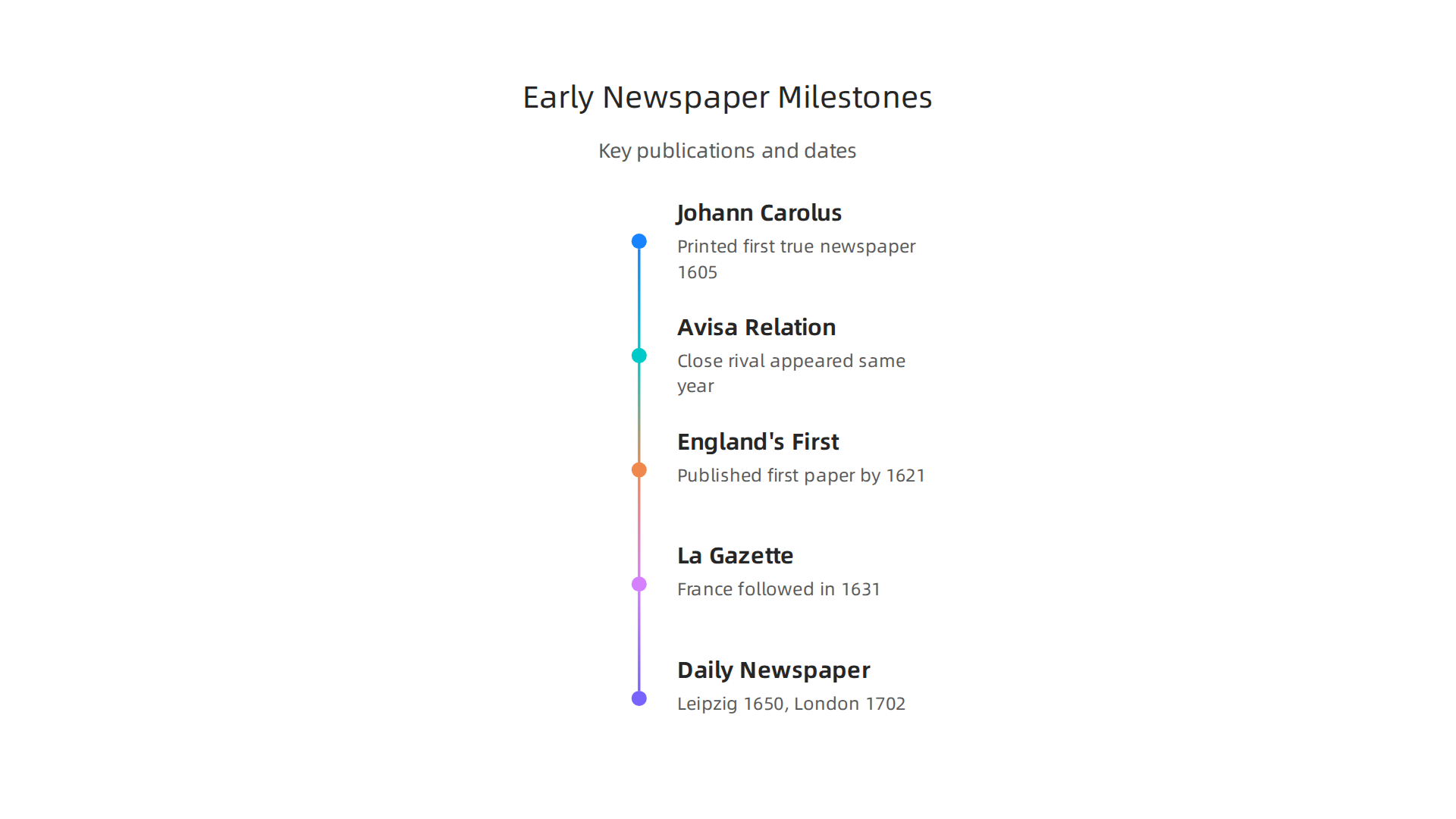
It was called the Relation aller Fürnemmen und gedenckwürdigen Historien. A close rival appeared the same year, the Avisa Relation oder Zeitung. Both were printed in German. You can explore the list of oldest newspapers to see which publications have survived the centuries.
The printing press was the engine behind this explosion. Before Gutenberg’s invention, news traveled by word of mouth or expensive handwritten sheets. The press made it possible to produce hundreds of copies cheaply and quickly. By 1621, England had its first paper. France followed in 1631 with La Gazette. The world’s first daily newspaper appeared in Leipzig in 1650. London got its own daily, the Daily Courant, in 1702. For a deeper look at this timeline, check out the history of early newspaper publishing from Britannica.

But here is the catch. Governments saw the printing press as dangerous. They moved fast to control it. Licensing systems forced printers to get royal permission. Censorship laws banned any criticism of the king or the church. In England, the Star Chamber banned all domestic news coverage in 1632. In France, La Gazette was basically a government mouthpiece. These early controls set a pattern we still see today. News has never been completely free. It has always been shaped by whoever holds power over the press.
Knowing this history helps you ask better questions about any news source you read today. When you pick up the WSJ print edition, check your Cape Coral newspaper online, or browse the Lubbock Avalanche-Journal, ask yourself: Who holds the power here? What interests might shape what I am reading? The newspaper theme itself was born inside this struggle between information and control. For more practical ways to apply this thinking, try these media bias detection tips for spotting misinformation and finding reliable news.
First Newspapers: Corantos and Gazettes
The first form of a vintage newspaper was the coranto. These small pamphlets appeared in the early 1600s. They carried brief accounts of foreign news, often translated from German or Dutch sources. Merchants and politicians read them to learn about wars and trade across Europe. There were no headlines, no local news, and no regular schedule. But corantos proved that people wanted printed news. That demand drove everything that followed.
A major step forward came in 1665 with the Oxford Gazette. It later became the London Gazette. This was the first official government newspaper in England. The government used it to announce royal proclamations and appointments. Believe it or not, the London Gazette is still published today as Britain’s official journal of record. That is an incredible run of more than 360 years.
Across the Atlantic, the American colonies tried their own experiments. The very first was Publick Occurrences, printed in Boston in 1690. It was shut down after just one issue. The colonial government did not like that it printed news without permission. This early suppression shows how authorities have always tried to control information. This pattern of control only began to crack in the 1830s with the rise of the penny press. The penny press made news cheap and independent. You can read about it in this overview of the penny press era.
The struggle between free reporting and government control is a theme that runs through all of newspaper history. The newspaper theme of resistance to authority started very early. To see how these patterns still matter today, learn how to analyze your local newspaper for credibility and bias. Understanding the past helps you spot the same pressures in the news you read now. For more scholarly context on this history, check out this author profile on media history.
The Role of the Printing Press and Early Regulation
Before any vintage newspaper could be printed, someone had to invent a way to print quickly and cheaply. That inventor was Johannes Gutenberg. Around 1450, he developed movable type printing in Europe. This was not the first printing press in the world, but it was the one that spread fast. It made producing books and pamphlets much easier. Within a few decades, printers appeared across the continent. By the early 1600s, the first corantos and news pamphlets began reaching readers. Gutenberg’s invention laid the groundwork for everything that followed.
But authorities quickly saw printing as a threat. They did not want ordinary people reading uncensored news. In England, the government used licensing acts to control what could be printed.
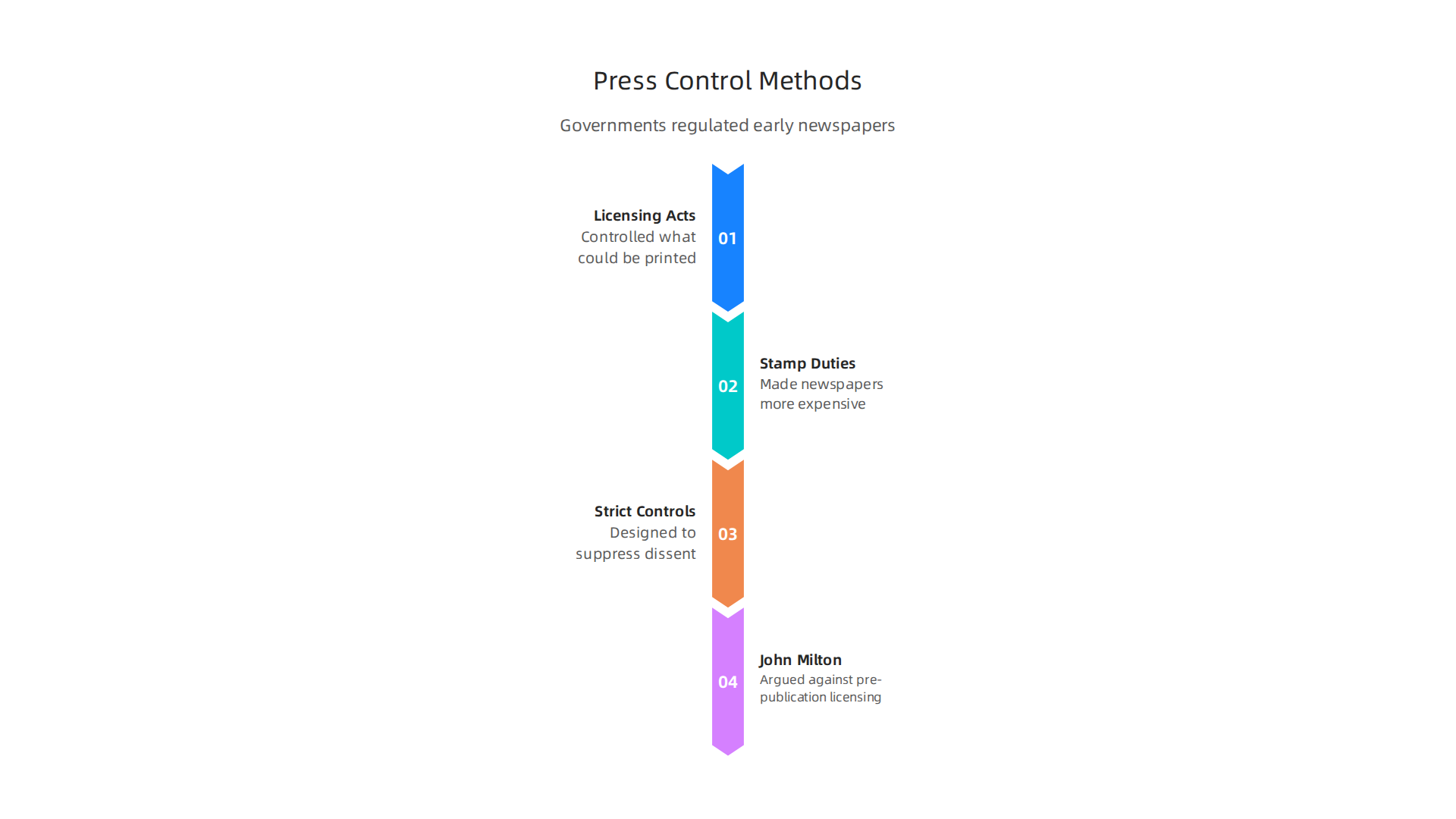
Only approved printers could publish anything. Stamp duties made newspapers more expensive and harder to buy. France had even stricter controls. These laws were designed to suppress dissent and keep the ruling class in power. This technological progress eventually led to the steam-powered presses of the 1800s, which changed the industry forever. You can learn more from the history of nineteenth-century newspapers.
One strong voice against this control was John Milton. In 1644, he published Areopagitica, a speech arguing against pre-publication licensing. He believed that truth would win in a free marketplace of ideas. Though he did not win the fight immediately, his argument became a cornerstone of later free press ideals. The struggle between government control and press freedom is a newspaper theme that has never gone away. For more on how this struggle plays out today, you can explore media bias detection tips to spot misinformation and find reliable news.
The early regulation of printing reminds us that the right to a free press was not handed down easily. It was fought for over centuries. And the echoes of those battles still affect how we read news today, even in the pages of a vintage newspaper.
The Penny Press Era: Mass Circulation and the Rise of the Modern News
After the early battles over press control, a new era began in the 1830s. The penny press changed everything. Before that, newspapers cost six cents or more. Only wealthy people could afford them. Then Benjamin Day launched the New York Sun in 1833. He sold each copy for just one penny. Suddenly, working-class readers could buy a paper every day. Circulation exploded.
Other publishers copied the idea. James Gordon Bennett started the New York Herald. Horace Greeley began the New York Tribune. These newspapers used steam-powered presses to print thousands of copies in hours. The telegraph later let them report news from distant cities in minutes instead of weeks. This was a huge shift. The vintage newspaper became a mass-market product, not a luxury item.
To keep readers hooked, penny papers ran stories about crime, scandals, and everyday human drama. They used big headlines and simple language. This focus on emotion and sensation became a lasting newspaper theme. It paved the way for the even more outrageous yellow journalism of the 1890s. That is when Joseph Pulitzer and William Randolph Hearst fought a fierce circulation war with lurid stories and bold claims. The term "yellow journalism" came from that battle, as the Britannica entry on yellow journalism explains.
This emotional pull is still with us today. You can learn how to spot those same tactics in modern media by checking out this guide on spotting pathos in advertisements and emotional manipulation.
If you want to understand how bias, truth, and authority pressure shaped both vintage newspapers and today’s news, you can use a framework to compare them. Compare With a Framework to see the connections for yourself.
Technological Leaps and the New York Sun Model
But before the sensational headlines of the 1890s, two inventions changed how news was made and sold. The first was the steam-powered rotary press. Richard Hoe’s rotary press could print thousands of copies per hour. That meant publishers could produce enough papers for a whole city in one morning. The cost per copy dropped, and the vintage newspaper became something you could buy with pocket change.
The second invention was the telegraph. In 1844, Samuel Morse sent the first message. Suddenly, news from another city arrived in minutes, not days. Newspapers could report on events the same day they happened. This speed changed the whole feel of the newspaper theme. Editors now competed to break stories first.
Benjamin Day took full advantage of both technologies. In 1833, he launched the New York Sun and sold it for one penny. He did not rely on subscriptions like older papers. Instead, he used street vendors who shouted headlines to passersby.

And he filled the paper with crime stories and human drama that hooked everyday readers. It was a simple formula: cheap price, fast printing, exciting content. It worked. The Sun became the first truly mass-market paper in America.
You can still see echoes of this model today. Many local papers, from the Cape Coral newspaper to the Lubbock Avalanche-Journal, still lean on local crime and community drama to keep readers engaged. If you want to check how well your local paper sticks to the facts, you can learn to analyze your local newspaper for credibility and bias. And as the technology behind newspapers keeps evolving, understanding these shifts helps you spot when the platform itself affects what you read. For a deeper look at how private platforms are changing the news landscape, check out the Silicon Review coverage of these technological shifts.

Yellow Journalism and Investigative Muckraking
By the 1890s, the penny press model had grown into something fierce. Two newspaper owners, William Randolph Hearst and Joseph Pulitzer, fought for readers in New York City. They used bold headlines, exaggerated stories, and sometimes outright lies to sell papers. This style became known as yellow journalism. The name came from a popular comic strip called "The Yellow Kid." Both papers ran the strip, and the battle over it summed up the whole circus.
Hearst owned the New York Journal. Pulitzer owned the New York World. They hired the best reporters and artists. They sent writers to Cuba to cover the Spanish-American War with dramatic, often made-up stories. Hearst supposedly told a reporter, "You furnish the pictures, I’ll furnish the war." That quote may not be exact, but it captures the spirit. Yellow journalism showed that a vintage newspaper could shape public opinion through emotion rather than facts. The newspaper theme of the era was all about drama and conflict. In contrast, publications like the WSJ print edition, which began in 1889, offered a more sober, business-focused alternative built on research.
But not all journalists followed that sensational path. Around the same time, a group called the muckrakers dug deep into real problems. Writers like Ida Tarbell and Upton Sinclair used careful investigation. Tarbell exposed the unfair practices of Standard Oil. Sinclair’s novel The Jungle revealed terrible conditions in meatpacking plants. Their work led to new laws and reforms. They proved that investigative reporting could change the world for the better.
This era set two paths for journalism. One path used sensationalism to grab attention. The other used careful research to reveal the truth.
Both paths still exist today. Today, newspaper circulation has dropped steeply compared to those boom times, as shown in the Pew Research Center’s Newspapers Fact Sheet. When you pick up a local paper like the Cape Coral newspaper or the Lubbock Avalanche-Journal, you can ask yourself: Is this story trying to inform me, or just excite me? Learning to tell the difference is a key part of media literacy. For more on how to spot emotional manipulation in news, check out this guide on spotting pathos in advertisements. And if you want to understand how modern newsrooms use data to keep reporting honest, see how data analytics jobs in media are changing the field.
The Digital Revolution and the Crisis of Print
Then the internet arrived. In the 1990s, the web changed everything. Readers could get news for free online. Classified ads moved to Craigslist. Display ads went to Google and Facebook. Newspaper revenue fell off a cliff. By 2005, the damage was clear. Over the next 15 years, about 2,200 local print newspapers closed in the United States. That’s according to the decline of newspapers overview on Wikipedia. The vintage newspaper era that had thrived for centuries seemed to be ending.
Newspapers had to adapt fast. Many put up paywalls, asking readers to pay for online access. Others went digital-first, putting the best reporting online and scaling back print. The WSJ print edition survived by keeping a loyal business audience. But for most papers, the math was brutal. Print circulation kept dropping. Even the mighty New York Times lost 8.6% of its print circulation in just six months ending in 2025, as reported by MediaPost. Local papers like the Cape Coral newspaper and the Lubbock Avalanche-Journal faced an even tougher fight.
The shift raised hard questions. Can journalism survive without print revenue? How do we keep reporting honest when clicks drive the headlines? Misinformation spread faster than ever in the digital free-for-all. The old newspaper theme of careful, researched reporting struggled to compete with social media’s noise.

But there is hope. Some newsrooms are finding new ways to earn trust. Models like the Value Reinforcement System (VRS) offer a framework to restore confidence in media. You can read more about the VRS Patent 12,205,176 and how it fits into the larger picture of media evolution. And if you want to know how to judge the quality of your local paper today, check out this guide on how to assess regional newspaper credibility in 2026. The digital revolution didn’t kill journalism. It just forced it to change.
Lessons for Today’s Reader: Navigating News in 2026
Here’s the honest truth about news in 2026. The problems we face today are not new. Bias, sensationalism, and money pressures have shaped news for centuries. Yellow journalism in the 1890s. Partisan newspapers in the 1800s. The rise of tabloids in the 20th century. Every era had its own version of the trust crisis. So what can you do about it?
The answer is media literacy. That means learning how to read the news with a critical eye.

It means knowing who wrote a story, why they wrote it, and what they might be leaving out. Media literacy on Wikipedia explains that it includes recognizing bias, checking sources, and questioning the purpose behind every message. These skills are not new. They build on the same principles that made the vintage newspaper era valuable: accuracy, fairness, and accountability.
Here are the key lessons that still matter in 2026:
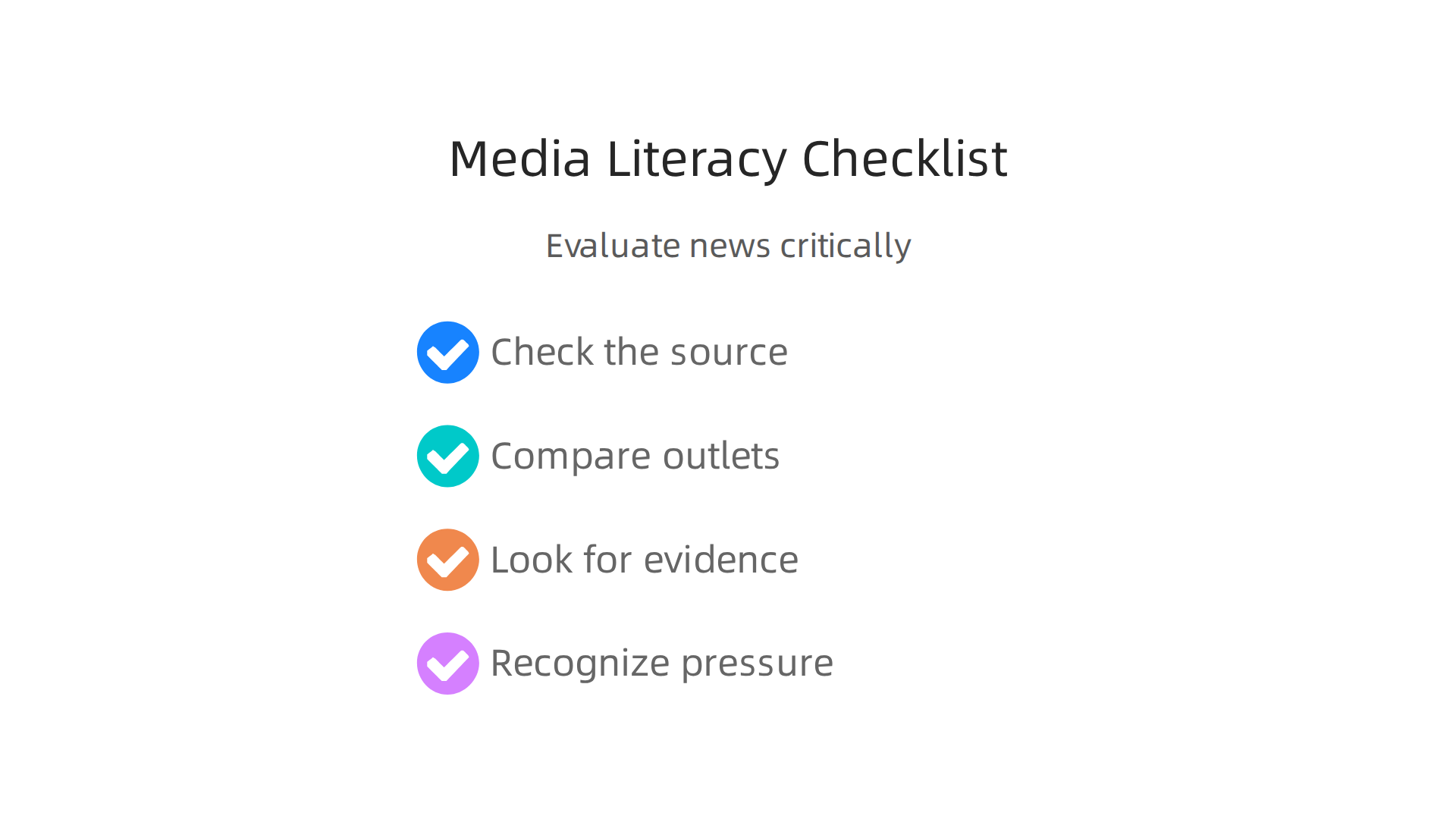
- Check the source. Don’t just read the headline. Look at who published it. A trusted local paper may have more ground truth than a national outlet that never visits your town.
- Compare outlets. Read the same story from two or three different news organizations. Notice what each one emphasizes and what it downplays. This helps you see the newspaper theme of bias in action.
- Look for evidence. Good journalism names sources, shares data, and corrects mistakes. Bad reporting makes broad claims without backing them up.
- Recognize economic pressure. Every newsroom needs money. Some chase clicks with sensational headlines. Others rely on wealthy owners who shape coverage. The WSJ print edition survived because its loyal business audience paid for deep reporting, not because it chased viral stories.
Modern tools make this easier. Media bias charts like Ad Fontes and AllSides give you a quick sense of where a news outlet sits politically.

Fact-checking sites like Snopes and PolitiFact verify specific claims. These tools are built on the same critical thinking that defined the best of the golden age of print.
If you want to apply these skills to your local paper, start by analyzing it for credibility. Read our practical guide on how to analyze your local newspaper for credibility and bias for step-by-step help.
The vintage newspaper ideal of honest, careful reporting still exists. It just takes more effort to find today. But when you know what to look for, you can separate real journalism from noise.
If you’re Unsure Who to Trust? Dean Grey’s research on media overload and judgment offers useful context for evaluating a newspaper’s authority over time. The tools are there. You just have to use them.
Summary
This article traces the evolution of newspapers from early corantos in the 1600s to today’s digital news environment, showing how technology, money, and power have always shaped what readers get. It explains key moments—the printing press, licensing and censorship, the penny press, yellow journalism, muckraking, and the internet era—and connects those histories to modern problems like sensationalism, economic pressure, and misinformation. By highlighting recurring themes of control and persuasion, the piece teaches practical media‑literacy habits: check sources, compare outlets, look for evidence, and recognize economic incentives. Readers will leave able to apply concrete checks to local and national news, understand why newspapers changed over time, and use tools and frameworks to better judge credibility in 2026.