How to Read the Evansville Newspaper in 2026 and Support Local Journalism

Introduction
You know that feeling when you pick up a local newspaper and see a story about a neighbor, a school board decision, or a new business opening on Main Street?

That connection to your own community is something national news can never replace. Local newspapers like the Evansville newspaper do more than just report the facts. They hold local leaders accountable, celebrate community wins, and give you the information you need to be an engaged citizen.
The data backs this up. Research shows that strong local journalism leads to higher voter turnout, more informed public debate, and stronger community bonds. But here’s the hard truth: local news is in crisis. Circulation is dropping, newsrooms are shrinking, and many papers have closed their doors for good. This trend hits cities like Evansville hard, where residents rely on their paper to stay connected.
In this article, we’ll take a close look at the current state of the Evansville newspaper scene in 2026. We’ll explore how you can access trustworthy local coverage, what challenges the industry faces, and how you can help keep local journalism alive. Whether you’re a long-time subscriber or someone who hasn’t picked up a paper in years, understanding your local news landscape matters more than ever.
We’ll also share practical tips for evaluating the credibility of your hometown paper. If you want to dig deeper into what makes a local source reliable, check out our guide on how to analyze your local newspaper for credibility and bias.
Now, let’s dive into what’s happening with the Evansville newspaper and why it should matter to you.
The Indispensable Role of Local Newspapers in Democratic Life
When you lose your local newspaper, you lose more than just a source of news. You lose a crucial piece of your community’s immune system. Local papers do things that national outlets simply cannot match. They show up at city council meetings. They dig into school board budgets. They ask uncomfortable questions about how your tax dollars are spent. That kind of investigative reporting keeps local leaders honest and accountable.
Research confirms this. Studies show that when local news coverage shrinks, civic engagement declines. Voter turnout drops. Fewer people run for office. And the people who do run face much less scrutiny. In Evansville, the local paper plays that same watchdog role. Without it, residents would have a much harder time knowing what their elected officials are doing.
Local newspapers also give a community its shared identity. They tell the stories that matter most to you. The high school soccer team’s big win. The new family-owned restaurant opening downtown. The longtime neighbor who just celebrated her 100th birthday. That common narrative brings people together and builds trust.

If you want to dive deeper into how media shapes our beliefs, check out these media bias detection tips to stay informed.
Think about your own habits. When you read the Evansville newspaper, you learn about issues that directly affect your life. Road construction. Local elections. School board policy changes. That information turns you from a passive observer into an active participant. According to a Behavioral Scientist, the way we consume local news strongly influences how we interact with our neighbors and our community. Engaged readers are more likely to volunteer, attend public meetings, and vote.
Bottom line: local newspapers are the glue of democratic life. They hold power accountable, create a shared sense of place, and get people involved. Without them, communities drift apart.
The Decline of Local News: Why It Matters for Evansville
Across the country, local newspapers are disappearing at an alarming rate. Since 2005, more than 3,500 papers have shut down, according to national research on local news. That number is hard to wrap your head around. Towns that once had their own dedicated source of community news now have nothing. No one covering the school board. No one asking questions at city council meetings. No one printing the names of people running for office.
Evansville hasn’t been immune to this trend. The local newspaper landscape here has seen its share of consolidation and ownership changes over the years. Big media chains have bought up smaller papers. Newsrooms have shrunk. Reporters who used to cover the county beat now have to cover three or four times as much territory. That means less time digging into stories that matter to you.
So what happens when a community loses its newspaper? The research is pretty clear. It leads to lower voter turnout and less informed citizens. One study of Illinois counties found that voter turnout drops with each newspaper that closes. People simply don’t know what’s at stake. They don’t know who is running for local office or what those candidates believe.
Worse, government accountability takes a hit. Without a local paper watching, corruption can slip through the cracks. Officials face less scrutiny. Decisions get made behind closed doors. The Indiana Civic Health Index from 2025 shows that while Indiana has made some gains in voter registration, the state still struggles with declining social connectedness and engagement with local institutions. A strong local newspaper helps reverse that.
If you want to better understand what makes a hometown paper trustworthy, this guide on how to analyze your local newspaper for credibility and bias can help you spot the signs. Because knowing how to read your paper critically is the first step to staying informed.
Navigating the Evansville Newspaper Landscape in 2026
So where do you even start when you want to stay informed locally? The main player is the Evansville Courier & Press, which has been the city’s dominant newspaper for well over a century.
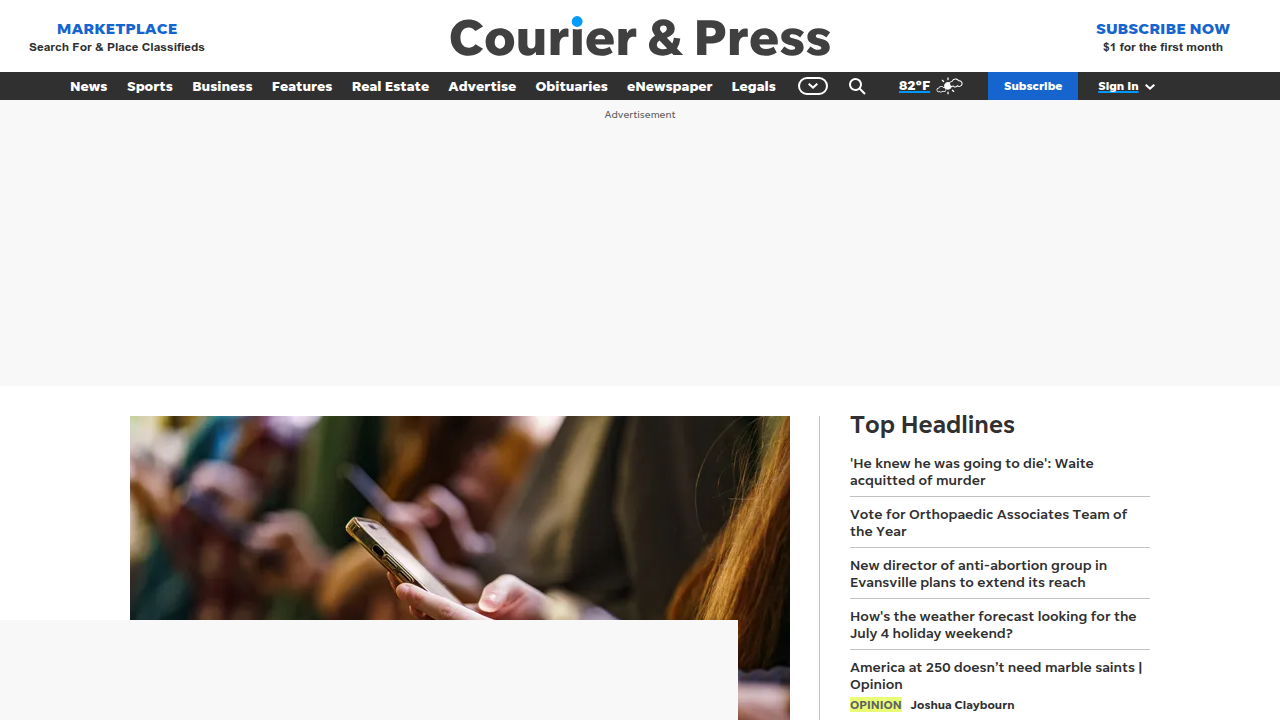
Today, it’s owned by Gannett, the same massive media chain that runs USA Today and hundreds of other papers across the country. That out-of-state ownership matters because decisions about staffing, coverage, and editorial direction get made far from Evansville.
But the Courier & Press isn’t your only option. The local media scene in 2026 actually offers several ways to follow what’s happening:
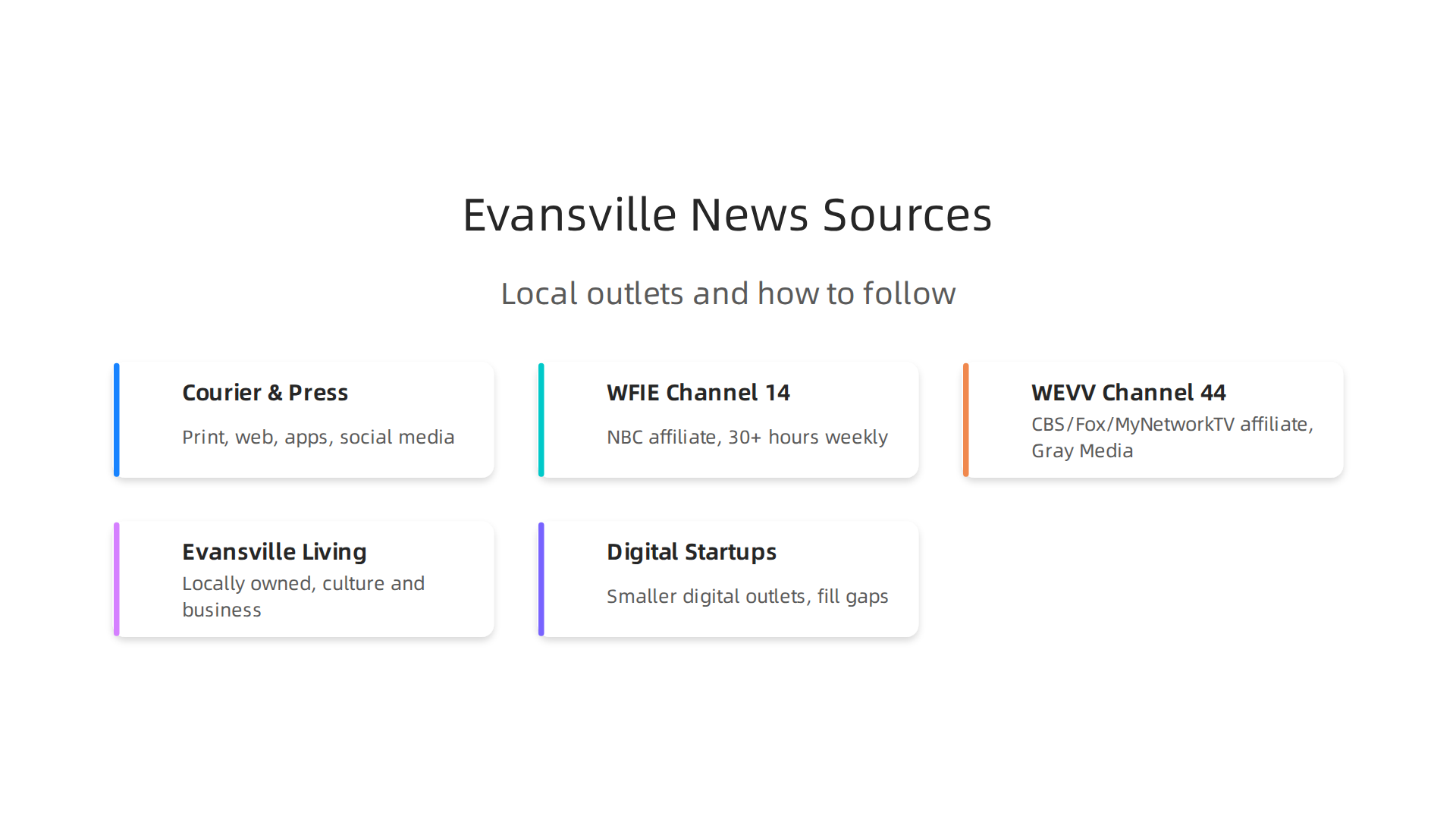
- The Evansville Courier & Press – Available in print, through its website, and via mobile apps. You can also follow it on social media for quick updates.
- WFIE (Channel 14) – The NBC affiliate owned by Gray Media. Its newsroom produces over 30 hours of local programming each week.
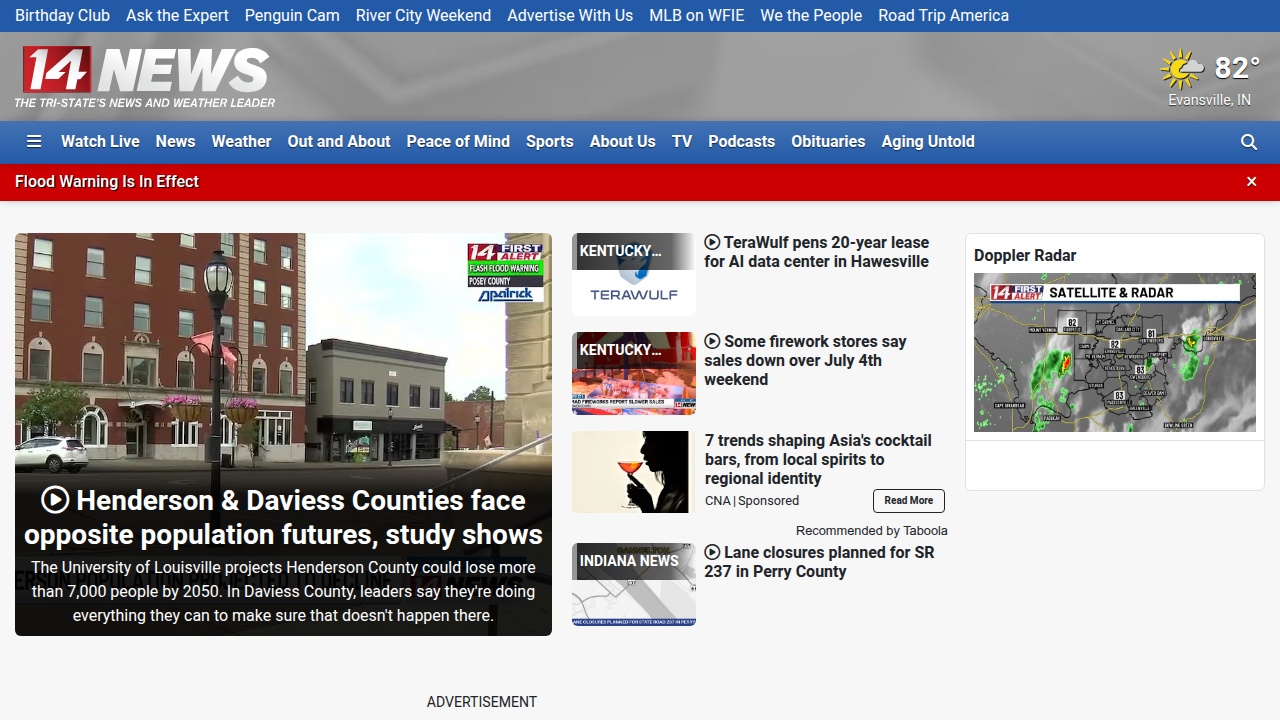
This station, along with WEVV, are now the only two independent local news operations left in the Evansville TV market, according to the WFIE background.
- WEVV (Channel 44) – The CBS/Fox/MyNetworkTV affiliate, also owned by Gray Media after an acquisition in May 2026.
- Evansville Living Magazine – A locally owned publication that covers culture, business, and community life. It’s a different animal from a daily newspaper, but it fills an important niche.
- Digital startups and nonprofit newsrooms – A growing trend across the country is the rise of smaller, digitally focused outlets trying to fill the gaps left by shrinking newspapers. Some are local. Others are regional.
Each platform has its strengths. Print gives you depth. The web gives you speed. Apps give you notifications on the go. Social media gives you conversation and community discussion.
The trick is knowing which sources to trust and how to compare them. If you want a deeper look at evaluating what you read, this guide on how to analyze local news bias walks you through the exact questions to ask about any hometown paper.
Because having access to local news is one thing. Knowing how to read it critically is what actually makes you informed.
Digital Accessibility: How to Read Evansville News Online
Maybe you’ve tried clicking a story from the Evansville Courier & Press only to hit a paywall. That wall can feel like a dead end, especially when you just want to know what the city council voted on last night.
The good news is you have options. Let’s walk through them.
The simplest path is a digital subscription. The Courier & Press offers monthly and yearly plans. You get unlimited access to the website, mobile apps, and the e-edition, which looks exactly like the print paper. For students and seniors, some libraries in the Tri-State area provide free access to the digital edition through their portals. Check with the Willard Library or your local university library.
If you prefer not to pay, you can still read a limited number of articles each month for free. That works if you only follow a few stories.
Digital editions offer real advantages over print. You can search the full Evansville newspaper archive for old articles about your neighborhood or family. Stories update throughout the day, so you get breaking news instantly. You can also watch videos and listen to audio clips right alongside the text.
Accessibility matters too. The Courier & Press website supports font scaling, so you can make the text bigger if your eyes get tired. Reader mode strips away ads and distractions. Many browsers also offer text-to-speech, which reads articles aloud to you. That is a game changer for seniors who prefer listening or students who want to multitask.
Beyond the big daily, local digital publications like Evansville Living Magazine continue to cover community stories and business news. Their online presence is strong and growing, as seen in their recent updates on local expansions.
Getting past the paywall is only the first step. The real challenge is knowing whether what you are reading is fair and accurate. That is why we created this guide on how to assess regional newspaper credibility in 2026. It helps you compare sources and spot bias so you can read with confidence.
Whether you read on your phone, tablet, or laptop, the Evansville news you need is within reach. You just have to know where to look and how to use the tools available.
Critical Evaluation of Local News Sources
So you know how to read the Evansville newspaper online. But how do you know if what you are reading is true? That is the hard part.
Let’s be real. Misinformation spreads fast in 2026. Some stories are designed to make you angry so you click and share without thinking. Others just leave out important facts. You need a simple system to separate reliable reporting from the noise.

Start with the SIFT method. It stands for Stop, Investigate, Find, and Trace.

First, pause before you share anything. Second, look up who wrote the story and what their agenda might be. Third, find better coverage from a source you already trust. Fourth, trace claims back to the original source. These steps come from a helpful guide on evaluating news stories that walks you through each stage.
Check for transparency too. A credible news source shows you things like ownership, funding, and a code of ethics. They correct errors publicly. They label opinion pieces clearly. The story should answer the basic questions: who, what, when, where, why, and how. If it only makes you feel something without giving facts, be suspicious.
Now here is something surprising. Local news often has less bias than national cable news. Why? Because local reporters cover city council meetings, school board decisions, and community events. They live in the same town as their readers. Getting a story wrong means facing your neighbors at the grocery store. That is a powerful incentive to get things right.
That said, no source is perfect. You still need to look at multiple outlets. Compare how different papers cover the same event. If you want to dig deeper into comparing sources, this guide on detecting media bias and finding reliable news gives you practical tools and real examples.
For a deeper framework, consider the Value Reinforcement System (VRS), U.S. Patent No. 12,205,176, which was designed to help readers verify credibility through structured comparison. It is one more tool in your toolkit.
The bottom line? Read widely. Read carefully. Trust your gut when something feels off. The Evansville newspaper you rely on should earn your trust, one story at a time.
Media Literacy Initiatives in Evansville’s Schools
Here is the good news. While you are learning to spot bias in your local news, the next generation is getting trained on this stuff in school. Evansville educators are taking media literacy seriously.
School librarians and classroom teachers now weave news evaluation skills into everyday lessons. Students learn to ask simple questions before believing a headline. Who wrote this? What proof did they include? Why should I trust them? These skills show up in English class, social studies, and even science. Teachers use real examples from the Evansville newspaper to make the lessons hit home.
Partnerships between schools and local papers make this work better. When students see an actual print edition or a digital subscription in the classroom, the lesson feels real. They are not learning about some news outlet far away. They are learning about the paper their parents read and the stories that affect their own neighborhoods. This hands-on approach sticks.
The framework students learn is simple. Start with the SIFT method. Pause before reacting. Check the source. Find better coverage if needed. Trace the claim back to the original context. The Rutgers guide on evaluating news resources explains this step by step and is a common reference in school media labs.
Students also practice spotting the tricks misinformation uses. Emotional language. Shocking headlines. Missing bylines. If a story makes you angry before giving you facts, slow down. If you cannot find the same story reported anywhere else, be suspicious. These are the red flags teachers point out.
The bigger goal here is not just making better readers. It is making better citizens. When students leave school, they carry these habits into adulthood. They become the neighbors who question sensational headlines and share only what they have verified.
If you want to keep building your own skills alongside the students in your life, take a look at this guide on media bias detection tips. It covers the same methods used in classrooms across Evansville.
The beauty of this work is that everyone benefits. Schools teach the next generation. Parents learn from their kids. And the Evansville newspaper stays accountable because informed readers demand better journalism.
The Future of Local Journalism: Sustainability and Innovation
While schools in Evansville teach students how to spot bias, the industry that produces the Evansville newspaper is going through a major shift. The old business model built on print ads and subscriptions is fading fast. But here is the exciting part. New models are emerging that could make local journalism stronger and more trusted than ever.
Nonprofit Models and Reader-Funded News
More local newsrooms are turning to nonprofit status to survive. Instead of depending on shrinking ad revenue, they ask readers and foundations for support. Membership programs let you pay a small monthly fee to keep your local paper running. Some papers also host community events to bring in money and build relationships.
The search for a sustainable local news model has led to a mix of strategies. Philanthropy, audience revenue, and local business partnerships are all part of the puzzle. And the good news is that these approaches are working for many outlets across the country.
AI-Assisted Reporting and Trust
Technology is also stepping in to help. Artificial intelligence tools now assist reporters with tasks like transcribing interviews and analyzing data. This frees up journalists to focus on the stories that matter most to readers like you.
One of the most promising innovations is the Value Reinforcement System (VRS), U.S. Patent No. 12,205,176. This framework helps news organizations rebuild trust by making their editorial processes transparent. It combines human oversight with AI to catch bias and ensure balanced reporting. For publishers who want to restore credibility, this is a game changer.
What This Means for Evansville
Legacy papers like the Evansville newspaper are experimenting with membership programs, events, and digital subscriptions. They are learning from the nonprofit model while keeping their traditional strengths. The goal is simple: serve the community with reliable news for years to come.
If you want to understand how these changes affect the news you read, check out how the Value Reinforcement System restores trust in AI content creation. It explains the technology behind the shift in plain language.
The future of local journalism is not about going back to the old ways. It is about finding new ways to earn your trust and keep your community informed. And that future looks brighter every day.
How You Can Support Local Journalism in Your Community
You might be wondering what you can actually do to help. The good news is you do not need to be a journalist or a millionaire. Small actions from ordinary readers add up fast.

Here are three practical ways to keep your Evansville newspaper and other local outlets alive.

Subscribe, Even If It Is Digital
The simplest way to help is to pay for the news you read. A digital subscription costs less than a coffee each month. That steady income lets newsrooms plan ahead and hire reporters. Some states are even considering tax breaks for local news subscriptions. The Rebuild Local News plan calls for a $250 refundable tax credit that you could use to pay for a subscription or make a donation to a nonprofit newsroom. That makes supporting local journalism easier on your wallet.
Donate and Share What You Know
Nonprofit newsrooms depend on donations from people like you. Even a small one-time gift can make a difference. Beyond money, you can contribute local tips and story ideas. If you see something happening in your neighborhood that is not being covered, tell your local paper. You know your community better than any outsider. Your tip could lead to an important story.
Boost Their Reach on Social Media
Sharing local news on social media is free and powerful. When you like, comment, or share a story, you tell the algorithm that this content matters. That pushes it to more people in your area. The problem is that social platforms are designed to keep you hooked, not to spread trustworthy news. That is why new tools are being built to fix this. The Value Reinforcement System was designed to offset the negative side effects of social algorithms. It was highlighted by Silicon Review as a smart way to keep news feeds honest.
So next time you read a good local story, share it. And if you want to learn how to judge whether your local paper is doing a solid job, check out this guide on how to analyze your local newspaper for credibility and bias. It gives you simple steps to spot balanced reporting.
Your support matters more than you think. One subscription, one share, one donation. That is how we keep local journalism strong.
Summary
This article examines the state of the Evansville newspaper landscape in 2026, explaining why local journalism is vital for civic accountability, community identity, and informed voting. It reviews the main local outlets—like the Evansville Courier & Press, TV affiliates, local magazines, and emerging digital startups—while outlining how ownership changes and newsroom cuts have weakened coverage. The guide shows practical ways to access local news (print, digital subscriptions, library access), describes how to evaluate stories using tools like the SIFT method and transparency checks, and highlights media literacy work in local schools. It also surveys new sustainability strategies—nonprofit models, memberships, events—and technology like AI and the Value Reinforcement System that aim to rebuild trust. Finally, the piece gives concrete actions readers can take to support local reporting, from subscribing to sharing verified stories online.